Huihai
Electric
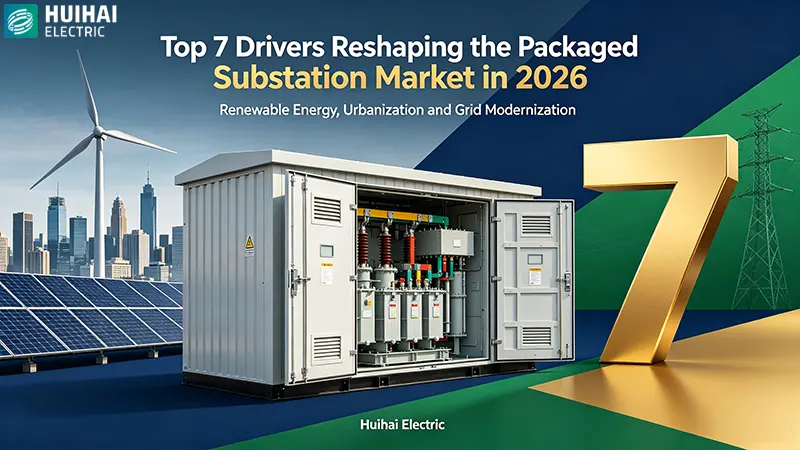
Packaged Substation Market Growth: Top 7 Drivers Reshaping the Industry in 2026
The global packaged substation market is undergoing a transformative shift. Valued at $19.24 billion in 2025, the market surged to $20.95 billion in 2026 at a compound annual growth rate (CAGR) of 8.9% , and is projected to reach $30.13 billion by 2030 at an accelerating CAGR of 9.5%.
But what's driving this remarkable growth? From the rapid integration of renewable energy to the digitalization of power grids, a convergence of technological, regulatory, and economic forces is reshaping the packaged substation landscape. Packaged substations—pre-engineered, factory-assembled units that integrate switchgear, transformers, protection systems, and controls into compact enclosures—are increasingly favored where project timelines, site constraints, and safety regulations create pressure to reduce on-site complexity.
Here are the top 7 drivers fueling the packaged substation market in 2026.
1. Renewable Energy Integration — The Primary Catalyst
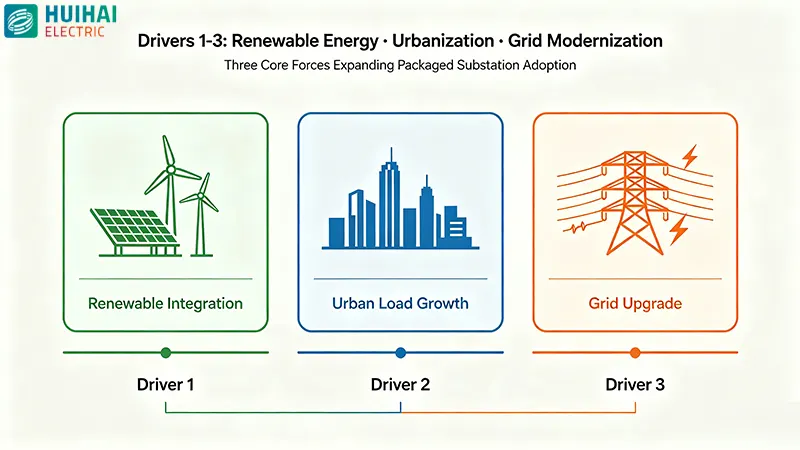
The increasing integration of renewable energy sources serves as a primary catalyst for the packaged substation market. Solar and wind farms are being deployed at scale across every continent, and with them comes the critical need for reliable, efficient power collection and transmission infrastructure.
Why packaged substations are essential for renewables:
- Decentralized generation: Packaged substations enable the efficient connection of decentralized solar and wind assets to the main electrical grid
- Remote deployment: Utilities utilize modular solutions to manage variable power flows and minimize on-site construction time at remote generation facilities
- Energy storage integration: Packaged substations play a key role in facilitating the connection of batteries and other energy storage systems, enabling the storage of surplus energy for later use
- Rapid deployment: Renewable energy projects require "fast construction, fast grid connection, and easy expansion"—prefabricated substations can significantly shorten construction cycles and meet flexible deployment needs
The numbers tell the story: In 2023 alone, renewable power capacity additions reached 473 GW. Renewable energy accounted for 24.5% of total energy consumption in the European Union in 2023, up from 23% in 2022. With global renewable capacity additions forecast to create cumulative demand of 2 TW by 2050, packaged substations are set to play an increasingly vital role in grid interconnection.
2. Rapid Urbanization and Industrialization
Rapid urbanization and industrialization are primary drivers for the packaged substation market, creating sustained and substantial demand for efficient, compact power distribution solutions.
What urbanization means for packaged substations:
- Space constraints: Urban densification elevates the value of space-saving designs. Packaged substations offer a compact footprint that fits within constrained urban environments, reducing land use by over 30% compared to conventional power facilities
- Underground applications: Driven by accelerating urbanization and the scarcity of land resources, packaged substations are finding increasingly widespread application in urban power grid upgrades, as well as in power supply projects for commercial and residential districts
- Government policies: Policies promoting the undergrounding of urban overhead power lines have further stimulated market demand
Regional impact: In China—the world's largest production and application market—urbanization, new energy grid integration, and rural power grid upgrades are driving rapid product upgrades from traditional 10kV to 35kV configurations.
3. Grid Modernization and Smart Grid Initiatives
The urgent necessity to modernize aging electrical infrastructure in developed economies is a powerful market driver. Grid modernization and smart grid initiatives are accelerating packaged substation adoption globally.
Why smart grids need packaged substations:
- Faster deployment: Packaged substations enable faster deployment, reduced on-site labor requirements, and greater standardization compared with traditional build approaches
- Reduced complexity: These solutions are increasingly favored where project timelines, site constraints, and safety regulations create pressure to reduce on-site complexity
- Digital integration: Digital protection, remote monitoring, and integration with distributed energy resources are becoming baseline expectations rather than optional enhancements
Investment context: Annual electricity grid investment must nearly double to meet global electrification and decarbonization goals. Grid modernization programs in North America and Europe are driving packaged substation procurement, with the U.S. substation automation segment expected to grow at the fastest CAGR from 2026 to 2033.
4. Digitalization and Smart Integration
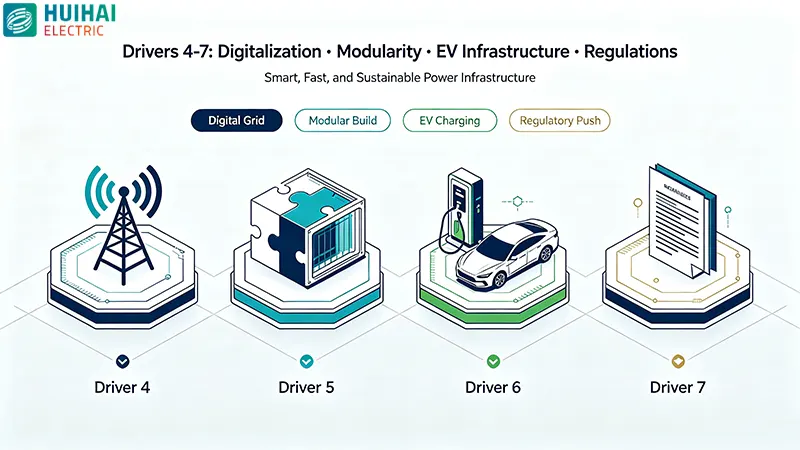
Digitalization and smart integration is identified as one of the prime reasons driving the global packaged substation market growth. Packaged substations are no longer passive blocks of metal—they are becoming intelligent nodes in the smart grid.
How digitalization is reshaping packaged substations:
- IoT-enabled monitoring: The integration of IoT-enabled real-time monitoring systems is transforming the packaged substation landscape, enabling utilities to transition from reactive to predictive maintenance strategies
- Smart sensors and IEDs: Digital substations utilize smart sensors and intelligent electronic devices to continuously analyze equipment health, reducing downtime and optimizing asset performance in complex grid networks
- Remote diagnostics: Integrated protection relays, condition monitoring sensors, and remote diagnostics have shifted expectations for commissioning and ongoing asset management
- Predictive maintenance: Smart enclosures reduce mean time to repair and enable predictive maintenance regimes, changing operational cost profiles and reliability expectations
Technological convergence: Digitalization is permeating secondary systems, with integrated protection and control platforms simplifying commissioning and interoperability. AI-enabled solutions can cut inspection time from days to minutes and reduce O&M labor costs by up to 70%.
5. Modularity and Prefabrication for Rapid Deployment
Modularity and prefabrication for rapid deployment are leading to sizable demand in the packaged substation market. Stakeholders are increasingly turning to pre-engineered, factory-assembled solutions to compress project timelines and reduce on-site complexity.
Key advantages driving adoption:
- Factory acceptance testing: Prefabrication and factory acceptance testing are increasingly prioritized because they reduce site labor intensity, compress schedules, and improve quality control
- Reduced on-site work: Packaged substations can be delivered and commissioned with minimal civil work disruptions
- Repeatable quality: Standardized module designs enable repeatable quality outcomes
- Faster electrification: Utilities, renewable energy developers, industrial operators, and infrastructure owners need faster electrification with predictable quality
Market validation: The modular prefabricated cabin substation market alone was valued at $2,171 million in 2025 and is forecast to reach $4,007 million by 2032, at a CAGR of 8.8%. This segment's growth reflects the broader industry shift toward prefabricated, modular solutions.
6. Expansion of Renewable Energy Interconnections and EV Charging Infrastructure
Beyond renewable generation itself, the expansion of renewable energy interconnections and electric vehicle (EV) charging infrastructure is a major market driver.
How interconnections drive demand:
- Grid connection infrastructure: Renewable energy integration is accelerating packaged substation procurement from solar, wind, and grid connection infrastructure operators globally
- EV charging networks: Power networks are being expanded and modernized to support electrification, renewable integration, and EV charging
- Distributed energy resources: The rise of distributed energy resources requires more flexible and modular point-of-presence distribution assets
Flexible power distribution: The market is driven by increasing demand for flexible power distribution systems that can adapt to changing load patterns from renewables and EVs. Packaged substations provide the modularity and scalability needed to accommodate these dynamic requirements.
7. Regulatory Pressures and Sustainability Imperatives
Policy and sustainability imperatives are reshaping specifications. Stricter emissions regulations and the need to integrate renewable generation are prompting interest in gas-insulated variants and compact configurations that can be sited in constrained urban footprints.
Regulatory drivers include:
- Stricter emissions regulations: New requirements around insulating gases, noise, and seismic resilience are encouraging material innovation and design standardization
- Environmental sealing improvements: Manufacturers are refining design paradigms to accommodate improved environmental sealing, enabling enclosures to perform reliably across a wider array of climates and operational contexts
- Compact, low-emission configurations: Regulatory and environmental drivers are encouraging a move toward compact, gas-insulated and modular configurations that lower footprint and emissions
- Policy-driven undergrounding: Government policies promoting the undergrounding of urban overhead power lines have further stimulated market demand
Regional policy impact: In Asia Pacific, government investment in smart grid modernization and large-scale smart city development programs are driving packaged substation adoption. China is accelerating the intelligent transformation of rural power grids, and offshore wind power booster stations are driving demand for prefabricated substations with high protection levels.
Regional Growth Spotlight: Asia Pacific Leads the Way
Asia Pacific is the fastest-growing region for packaged substations, contributing 39.6% of the global market share in 2026. This growth is driven by:
- Rapid urbanization and infrastructure development across China, India, and Southeast Asian nations
- Large-scale renewable energy projects that use prefabricated substation solutions
- Smart grid investment and large-scale smart city development programs
- Industrial expansion and power infrastructure modernization
- Rural power grid upgrades and intelligent transformation initiatives
The region's dominance is expected to continue, with APAC forecast to account for 55.4% of market growth during the forecast period.
Summary: The 7 Drivers at a Glance
| # | Driver | Key Impact | Market Data |
| 1 | Renewable Energy Integration | Primary catalyst for packaged substation procurement | 473 GW capacity added in 2023; 24.5% of EU energy from renewables |
| 2 | Rapid Urbanization & Industrialization | Demand for compact, space-saving power solutions | Urban densification elevates value of space-saving designs |
| 3 | Grid Modernization & Smart Grids | Digital protection, remote monitoring, DER integration | Annual grid investment must nearly double |
| 4 | Digitalization & Smart Integration | IoT monitoring, predictive maintenance, AI-driven O&M | Smart enclosures reduce mean time to repair |
| 5 | Modularity & Prefabrication | Faster deployment, reduced site labor, quality control | Modular cabin substation market: $2.17B in 2025 |
| 6 | Renewable Interconnections & EV Charging | Flexible power distribution for dynamic loads | EV charging and renewables driving grid expansion |
| 7 | Regulatory Pressures & Sustainability | Lower emissions, compact configurations, policy compliance | Undergrounding policies stimulating market demand |
Why Huihai Electric for Your Packaged Substation Projects
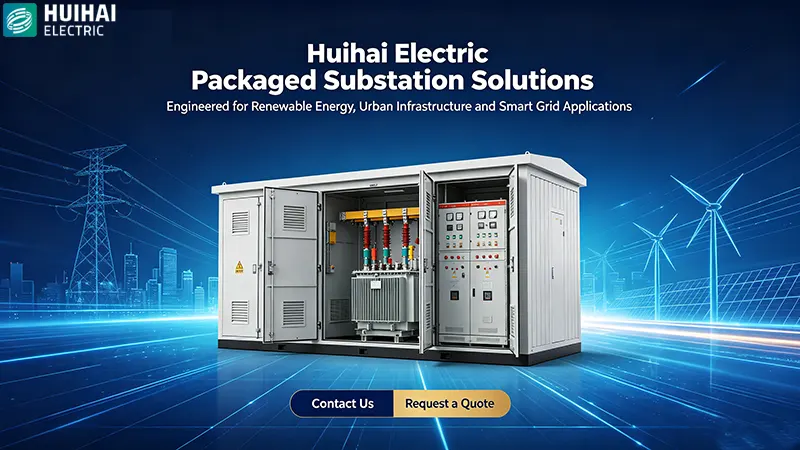
At Huihai Electric, we understand that the packaged substation market is being reshaped by these seven powerful drivers. Our prefabricated substation solutions are engineered to meet the demands of renewable energy projects, urban infrastructure, and smart grid applications:
- Renewable-ready: Designed for solar, wind, and BESS integration with rapid deployment capability
- Urban-optimized: Compact, space-saving configurations for constrained urban footprints
- Smart grid compatible: IoT-enabled monitoring and SCADA integration for digital substations
- Modular by design: Factory-assembled, pre-tested units for quality and speed
- Sustainability compliant: Environmentally friendly designs meeting emissions and safety regulations
- Full standards compliance: IEC 62271-202, IEC 60076, and IEEE standards
Whether you are expanding renewable energy capacity, modernizing urban distribution networks, or developing industrial infrastructure, Huihai Electric delivers packaged substation solutions built for the drivers shaping the industry in 2026—and beyond.
Written by
Huihai Electric Co., Ltd.
Editor Xu
www.huihai-electric.com
WhatsApp:+86 139 1136 0187
Email:info@huihai-electric.com
- Top 7 Benefits of Dry-Type Transformers for Industrial Power Projects in 2026
- Top 7 Applications Driving Dry-Type Transformer Demand in 2026 — From Data Centers to Petrochemicals
- Top 5 Resin Technologies That Are Extending Dry-Type Transformer Life Beyond 35 Years
- Top 9 Best Questions to Ask Your Dry-Type Transformer Manufacturer Before Buying
HUIHAIElectric
Huihai Electric is a leading manufacturer of smart grid equipment in China.