Huihai
Electric
Top 9 Best Questions to Ask Your Dry-Type Transformer Manufacturer Before Buying
Purchasing a dry-type transformer is a major capital investment—often ranging from $10,000 to over $500,000 depending on rating, voltage class, and customization. A wrong specification or an unreliable manufacturer can lead to catastrophic failures, unplanned downtime, safety hazards, and millions of dollars in operational losses.
Yet many procurement teams rush through the supplier evaluation process, focusing on price and delivery while overlooking critical technical and quality factors. The global market for dry-type transformers reached approximately $6.5 billion in 2025, and China alone produces roughly 40-45% of global transformer capacity. With so many manufacturers—and significant variation in quality among them—asking the right questions before signing a purchase order is essential.
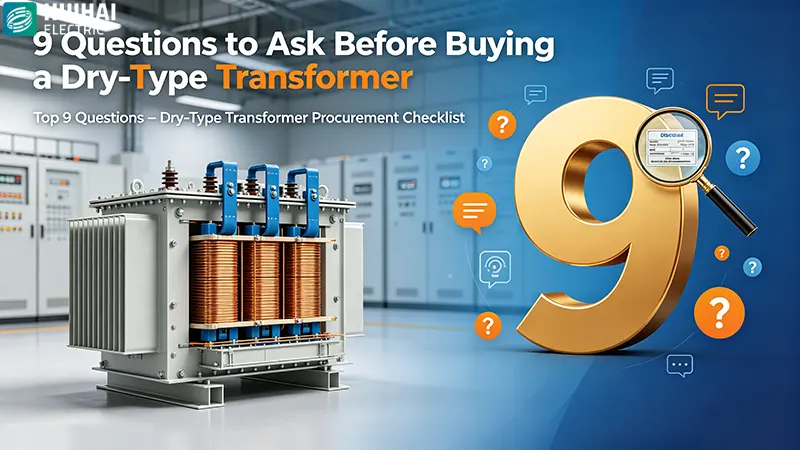
Here are the top 9 best questions you must ask your dry-type transformer manufacturer before buying.
1. What Is the Correct kVA Rating for My Application—and Have You Included a Safety Margin?
Sizing is the foundation of transformer procurement. An undersized transformer will overheat and fail prematurely; an oversized transformer wastes capital and increases no-load losses.
What to Ask:
Based on our load profile, what kVA rating do you recommend? Have you included a safety margin for future expansion?
Why It Matters:
Start by determining the rated capacity based on your actual load, with a recommended 20% margin for peak demands. For modern industrial facilities with variable frequency drives (VFDs) and data center equipment, specific K-Factor analysis is essential to ensure the transformer can handle harmonic loads without overheating.
A common procurement mistake is simply matching current load without considering future growth. If your actual load is 800 kVA, selecting a 1000 kVA unit provides room for expansion—but there is no need to oversize to 1250 kVA, which would add unnecessary cost.
Red Flag: The manufacturer recommends a rating based solely on current load without discussing peak demand or future expansion.
2. What Are the Primary and Secondary Voltage Ratings—and Are They Matched to Our System?
Voltage mismatch is one of the most expensive and frustrating procurement errors. A transformer delivered with the wrong voltage configuration may require costly on-site rewinding or complete replacement.
What to Ask:
What are the guaranteed primary and secondary voltage ratings? Does the transformer include the tapping range we need for our voltage fluctuations?
Why It Matters:
Confirm both primary and secondary voltage ratings—such as 10kV/0.4kV, 11kV/0.415kV, or other configurations matching your system. Also verify the tapping range (e.g., ±2×2.5% on the primary winding) to accommodate voltage fluctuations in your grid.
If special functionality like multiple windings is required, ensure this is incorporated into the design. The frequency must also match local standards—50Hz in most countries or 60Hz in regions like the United States.
A real-world cautionary tale: one procurement team awarded a 1,600 kVA dry-type order to the lowest bidder. The units arrived on time, but the tap changer configuration was set for 400 V secondary when the project required 415 V. The retrofit cost $14,000 and delayed commissioning by two weeks.
Red Flag: The manufacturer cannot clearly specify the voltage class, tapping range, or frequency compatibility.
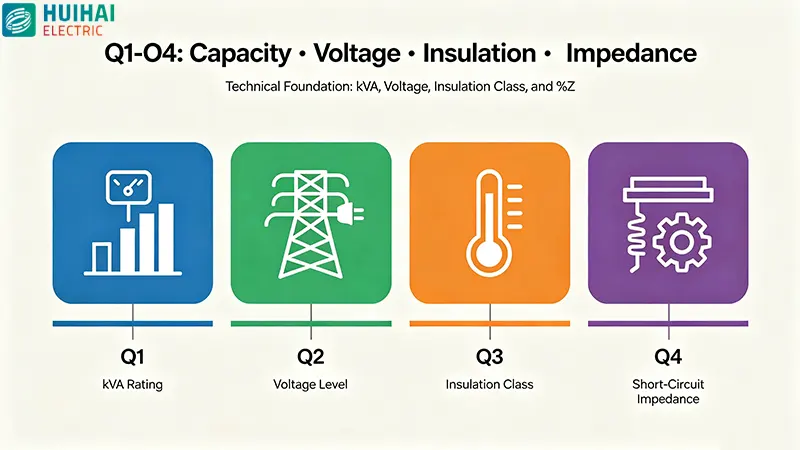
3. What Insulation Class and Temperature Rise Limits Do You Guarantee?
Insulation class and temperature rise directly determine transformer life. According to the Arrhenius aging model, every 10°C above rated temperature halves insulation life.
What to Ask:
What insulation class (F or H) do you use? What are the guaranteed average and hot-spot temperature rises at rated load and 40°C ambient?
Why It Matters:
The most common insulation classes are Class F (155°C) and Class H (180°C). Class F offers a balanced cost-performance ratio for regular indoor applications; Class H provides stronger high-temperature and overload resistance for harsh environments.
Per IEC 60076-11 and IEEE C57.12.01 standards, typical temperature rise limits include:
- Winding average temperature rise: 65°C for Class A, up to 100°C for Class F
- Hot-spot temperature: Shall not exceed specified limits
If the insulation class is selected too low for the operating environment, the equipment will age rapidly and may suffer insulation breakdown in high-temperature conditions.
Red Flag: The manufacturer cannot provide temperature rise test reports or offers vague guarantees without specific numbers.
4. What Is the Short-Circuit Impedance (%Z)—and Does It Match Our System's Fault Current Capacity?
Short-circuit impedance (%Z) determines voltage regulation and the magnitude of fault currents the transformer can withstand. An incorrect %Z can compromise protection coordination and system safety.
What to Ask:
What is the guaranteed short-circuit impedance at rated temperature? What is the tolerance band? Does the transformer meet the short-circuit withstand requirements of IEC 60076-5 or IEEE C57.12.90?
Why It Matters:
Standard distribution transformers typically use 4% to 6% impedance. For large-capacity systems or applications requiring parallel operation, 6% to 8% is recommended.
If the impedance is too low, short-circuit currents will be excessively large, potentially damaging equipment. If too high, voltage loss increases. The transformer's short-circuit withstand capacity must be verified—products complying with IEC 60076-5 or IEEE C57.12.90 standards and capable of withstanding short-circuit impacts are essential for coping with sudden grid failures.
Red Flag: The manufacturer cannot provide short-circuit test reports or specifies %Z without referencing applicable standards.
5. What Cooling Method Do You Recommend—and What Is the Derating Factor for Our Installation Environment?
The cooling method affects the transformer's continuous rating, overload capability, footprint, and maintenance requirements.
What to Ask:
What cooling class (AN, AF, or AN/AF) do you recommend for our installation? What is the derating factor if ambient temperature exceeds 40°C or if airflow is restricted?
Why It Matters:
Common cooling methods include:
- AN (Air Natural): Natural convection cooling, suitable for transformers up to 1000 kVA in well-ventilated environments
- AF (Air Forced): Forced air cooling via fans, better for larger units but requires fan maintenance and additional energy
- AN/AF: Dual rating—full capacity with fans, derated without
When airflow is obstructed or ambient temperature exceeds 40°C, a transformer's rating may be significantly reduced. Clarifying the installation environment, load characteristics, and budget constraints is the first step for scientific equipment selection.
Protection level also matters: IP20 is suitable for standard indoor use; IP23 or higher is required for outdoor or rain-prone areas. Choosing a low protection level for poor environmental conditions will cause the equipment to accumulate dust and moisture, leading to premature failure.
Red Flag: The manufacturer does not discuss derating requirements or assumes ideal installation conditions without site-specific analysis.
6. What Type Tests Have Been Performed—and Can You Provide the Reports?
Type tests validate the transformer's design and performance under extreme conditions. A manufacturer that cannot provide complete type test reports is effectively selling unproven equipment.
What to Ask:
Can you provide complete type test reports from an accredited independent laboratory for this exact design and rating? What tests are included—and which are routine vs. type tests?
Why It Matters:
Genuine manufacturers perform rigorous testing. Routine tests (mandatory for every unit) include:
- Winding resistance measurement
- Turns ratio test and vector group verification
- Measurement of core loss and winding loss
- Insulation resistance testing
Type tests (design validation) include:
- Lightning impulse withstand test (BIL)
- Power frequency withstand test
- Temperature rise test (heat run)
- Short-circuit withstand test
- Partial discharge measurement—one of the most sensitive indicators of insulation quality
Self-certified claims are common; what matters are third-party type-test reports from accredited laboratories such as KEMA, CESI, or UL. For dry-type transformers, IEC 60076-11 and IEEE C57.12.01 are the governing standards.
Red Flag: The manufacturer offers "type tested" claims but cannot provide actual test reports—or tests were conducted on smaller units and extrapolated.
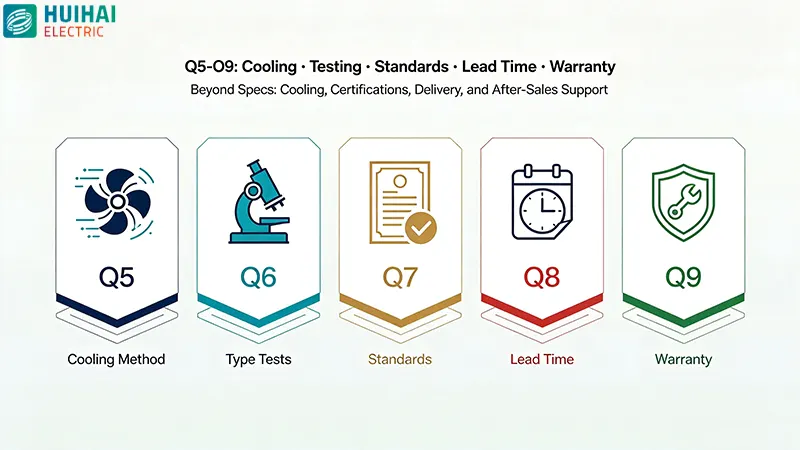
7. What Standards Do You Comply With—and Do You Have Third-Party Certifications?
Standards compliance ensures safety, performance, and global interoperability. A supplier's certification defines the grid's safety level.
What to Ask:
Which international standards do your transformers comply with (IEC, IEEE, GB)? Can you provide third-party certifications such as ISO 9001, CE, CQC, or KEMA?
Why It Matters:
Key standards for dry-type transformers include:
- IEC 60076-11 (Dry-type power transformers)
- IEEE C57.12.01 (General requirements for dry-type distribution and power transformers)
- IEEE C57.12.91 (Test code for dry-type transformers)
- GB/T 10228-2023 (Chinese standard, with new energy efficiency requirements effective 2026)
Look for certifications including ISO 9001 (quality management), ISO 14001 (environmental management), CE (European compliance), CQC (China Quality Certification), and KEMA (independent testing).
For international use, ensure products comply with IEC standards and provide full documentation for IEC, IEEE, and AS/NZS standards—making the manufacturer a "global-ready" partner.
Red Flag: The manufacturer claims "equivalent to" standards without formal certification or hesitates to share certification documentation.
8. What Is the Realistic Lead Time—and Can You Meet Our Project Schedule?
In a market where delays can cost thousands of dollars per day, supply chain transparency is vital.
What to Ask:
What is the realistic lead time for our specific configuration? Do you have the engineering and production capacity to meet our schedule?
Why It Matters:
Lead times vary significantly based on customization:
- Standard units: Typically 4-8 weeks
- Custom designs: Typically 10-16 weeks
- Vertical integration allows some manufacturers to deliver standard 10kV/35kV distribution transformers within 4-6 weeks, while the industry average is longer
Verify that the manufacturer has an engineering team, not just sales staff. Custom voltage, kVA, enclosure, and cooling modifications represent 30-40% of export orders—confirming engineering capability is essential.
Red Flag: The manufacturer promises unrealistic lead times or cannot provide a clear production schedule.
9. What Is Your Warranty—and Do You Stock Spare Parts Locally?
Even the highest-quality transformer will eventually require maintenance or spare parts. A manufacturer's after-sales capability is as important as the product itself.
What to Ask:
What warranty terms do you offer—and what does the warranty cover? Do you stock spare parts locally or ship them promptly upon request? What is your typical field support response time?
Why It Matters:
A comprehensive warranty typically covers defects in materials and workmanship for five to ten years. Some manufacturers go further by providing performance guarantees, assuring that core losses and temperature rise remain within specified limits.
Inquire about available maintenance services:
- Periodic field inspections
- Infrared scanning
- Cleaning services to prevent moisture ingress and contamination
Spare parts availability is critical. Ask whether spare parts and replacement coils are stocked locally or shipped swiftly upon request. When a transformer fails, every hour of downtime costs money—sometimes millions of dollars.
Also discuss payment terms: set reasonable terms such as a partial advance and a 10% quality retention to be paid upon final acceptance.
Red Flag: The manufacturer offers minimal warranty coverage, cannot provide spare parts lead times, or has no local service presence.
Summary: Your 9-Question Procurement Checklist
| # | Question | Why It Matters |
| 1 | What kVA rating—and is there a safety margin? | Prevents undersizing or oversizing |
| 2 | What are the voltage ratings and tapping range? | Avoids costly voltage mismatch |
| 3 | What insulation class and temperature rise? | Determines transformer life |
| 4 | What is the short-circuit impedance (%Z)? | Affects protection coordination and fault current |
| 5 | What cooling method—and what derating? | Ensures reliable operation in your environment |
| 6 | What type tests—and can we see the reports? | Validates design and performance |
| 7 | What standards and certifications? | Ensures safety and global compliance |
| 8 | What is the lead time? | Meets project schedule |
| 9 | What warranty and spare parts support? | Protects long-term asset value |
Why Huihai Electric Meets All 9 Questions
At Huihai Electric, we understand that transformer procurement is a high-stakes decision. Our dry-type transformers are designed and manufactured to the highest international standards, with complete documentation for every unit.
What you get with Huihai Electric:
- Accurate sizing with engineering review and safety margins
- Full voltage matching with custom tapping ranges
- Class F or H insulation with guaranteed temperature rise limits
- Optimized impedance for your system's fault current capacity
- AN, AF, or AN/AF cooling with site-specific derating analysis
- Complete type test reports from accredited laboratories
- IEC 60076-11, IEEE C57.12.01, and GB compliance with third-party certifications
- Realistic lead times with transparent production scheduling
- Comprehensive warranty and responsive after-sales support
Whether you are upgrading industrial power distribution, expanding a data center, or integrating renewable energy, Huihai Electric delivers dry-type transformers you can rely on—backed by rigorous quality control and decades of manufacturing expertise.
Ready to specify your next dry-type transformer? Contact Huihai Electric to request technical documentation, schedule a factory audit, or discuss your project requirements with our engineering team.
Written by
Huihai Electric Co., Ltd.
Editor Xu
www.huihai-electric.com
WhatsApp:+86 139 1136 0187
Email:info@huihai-electric.com
- 6 Advantages of Prefabricated Substations Over Traditional Stick-Built Designs
- Basic Winter Maintenance Measures for Oil-Immersed Transformers
- Avoid Costly Mistakes: 8 Dry-Type Transformer Specs to Verify Before Purchase
- High Voltage Switchgear Installation Guide: 10 Steps for Safe and Reliable Commissioning
HUIHAIElectric
Huihai Electric is a leading manufacturer of smart grid equipment in China.