Huihai
Electric
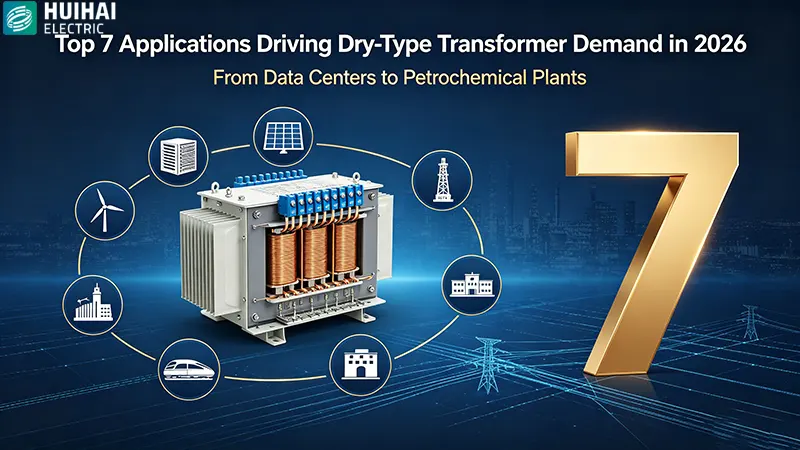
Top 7 Applications Driving Dry-Type Transformer Demand in 2026 — From Data Centers to Petrochemicals
The global dry-type transformer market is experiencing a remarkable transformation. Valued at $7.1 billion in 2025, the market surged to $7.66 billion in 2026 at a CAGR of 7.9% and is forecast to reach $10.26 billion by 2030.
What's driving this growth? The answer lies in seven critical applications where dry-type transformers have become the technology of choice—not just for their fire safety and environmental benefits, but for their ability to meet the unique demands of modern, digital, and increasingly electrified industries. From the hyperscale data centers powering the AI revolution to the harsh, hazardous environments of petrochemical plants, here are the top 7 applications fueling dry-type transformer demand in 2026.
Application 1: Data Centers — The AI-Driven Powerhouse
Data centers represent the fastest-growing application for dry-type transformers. The explosive growth of artificial intelligence, cloud computing, and hyperscale infrastructure has created unprecedented demand for reliable, fire-safe, and high-density power distribution.
Market Snapshot
The global dry-type transformers for data center market was valued at $1.123 billion in 2025 and is forecast to reach $2.814 billion by 2032, growing at a remarkable CAGR of 14.2%. Within this segment, the AI data center dry-type transformer market is projected to reach $4.55 billion by 2032, at a stunning CAGR of 30.7%.
Why Dry-Type?
- Fire safety is non-negotiable: Data centers are indoor, mission-critical facilities. Dry-type transformers eliminate the fire risk of flammable oil, making them essential for hyperscale, edge, and enterprise data centers.
- Space constraints: Their compact design and thermal resistance support installation in confined server rooms and electrical rooms.
- Increasing power density: Rising rack power densities and higher overall loads demand transformers with better thermal stability, higher insulation class, and low-loss performance.
- Quieter operation: Dry-type units operate with lower noise levels, critical in urban data center environments.
Key Trend: Amorphous alloy transformers, with ultra-low no-load losses (60-70% lower than traditional silicon steel transformers), are gaining popularity in hyperscale data centers. Chinese vendors are achieving competitive differentiation in emerging scenarios like edge data centers through rapid response and customized services.
Application 2: Renewable Energy — Solar, Wind, and Storage
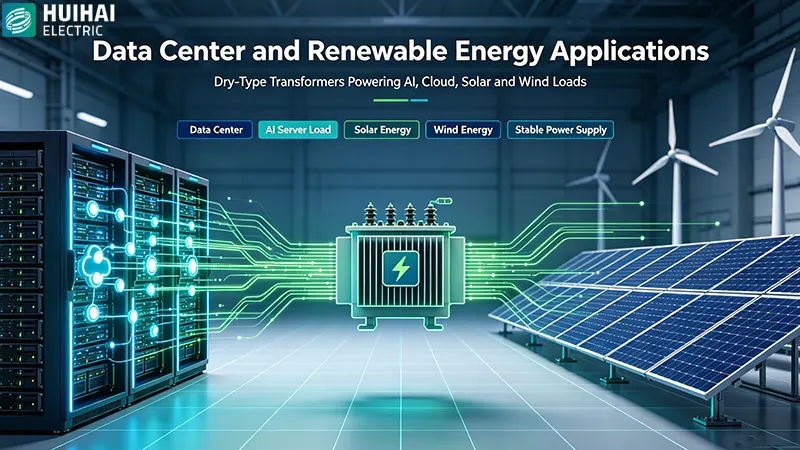
Renewable energy infrastructure is one of the most significant drivers of the dry-type transformer market. As solar and wind projects multiply globally, the requirement for environmentally friendly, fire-safe transformers becomes urgent.
Market Context
Global renewable capacity additions are forecast to create cumulative step-up demand of 2 TW by 2050. Dry-type transformers play a key role in supporting renewable energy systems by enabling the safe and efficient integration of wind and solar power into the grid.
Solar Farms
Solar farms require efficient voltage regulation and power distribution systems. Dry-type transformers are widely preferred in these applications due to their safety, low maintenance, and environmental benefits. Solar farms, rooftop PV systems, and mountain solar installations are often located where fire protection and maintenance access are difficult, making dry-type technology the logical choice.
Wind Power — Onshore and Offshore
- Onshore wind: Dry-type transformers are used in wind turbine nacelles and collector substations, where oil-filled units present flammability dangers.
- Offshore wind: Offshore wind developers are standardizing IP56-rated cast-coil designs that withstand salt spray and harsh marine environments.
- Market growth: The offshore transformer market—including dry-type units—was valued at $3.2 billion in 2025 and is projected to expand to $6.4 billion by 2034 at an 8.7% CAGR.
Battery Energy Storage Systems (BESS)
Integrated energy storage projects require bidirectional transformers capable of handling cyclical charge-discharge regimes. Dry-type transformers are increasingly specified for these applications due to their reliability and low maintenance.
Key Trend: Pad-mounted dry-type configurations cut installation costs by 15-20% because they eliminate oil-containment vaults, shaving up to 12 weeks from construction schedules in environmentally sensitive zones.
Application 3: Petrochemical Plants — Safety in Hazardous Environments
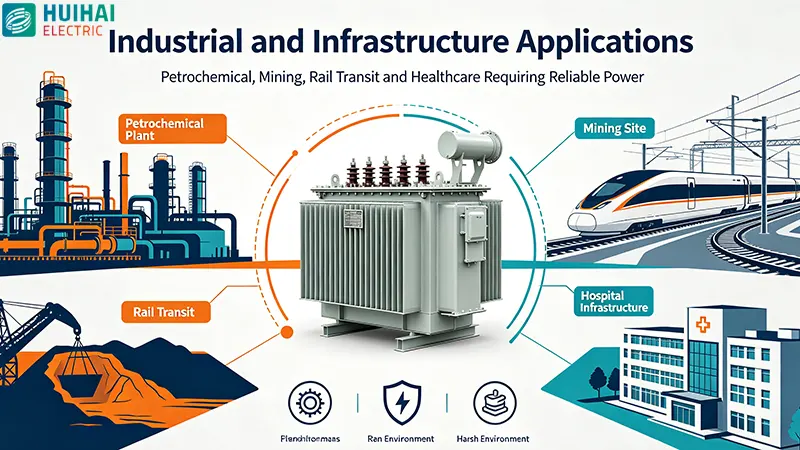
Petrochemical plants, refineries, and chemical processing facilities operate in environments where volatile flammable liquids or gases are handled, processed, or used. These are among the most demanding applications for any electrical equipment.
Why Dry-Type?
- Explosion and fire safety: In hazardous locations where ignitable concentrations of gases or vapors may be present, dry-type transformers eliminate the risk of oil fires.
- Corrosion resistance: Chemical plants, petrochemical facilities, and wastewater treatment plants require exceptionally durable, corrosion-resistant transformers that can withstand exposure to chemicals, water, and other severe conditions.
- Zero oil leaks: No risk of environmental contamination from oil spills—critical in environmentally sensitive industrial settings.
Applications Across the Sector
Dry-type transformers power all aspects of power distribution—from the main substation to every sector of the refinery, petrochemical plant, offshore platform, and marine vessel. They are specifically designed for:
- Oil and gas exploration, petroleum refining, and natural gas extraction
- Chemical and petrochemical processing plants
- Offshore oil platforms with high salt spray and humidity
Key Insight: In Saudi Arabia, the industrial segment (including oil & gas and petrochemicals) is the dominant end-user in the dry-type transformer market. These transformers are also widely utilized in food processing and pulp and paper sectors to prevent contaminants from damaging transformer components.
Application 4: Healthcare — Critical Power for Life-Saving Equipment
Hospitals and healthcare facilities represent a growing segment for dry-type transformers. With strict safety, noise, and reliability requirements, healthcare infrastructure is increasingly turning to dry-type technology.
Why Dry-Type?
- Zero fire risk: Hospitals require non-toxic, fire-safe power sources in critical, sensitive environments. Dry-type transformers eliminate the fire hazard of oil-filled units in densely occupied spaces.
- Low audible noise: Hospitals demand quiet operation. Low-voltage dry-type transformers can achieve noise reduction of 15-25 dB compared to conventional designs, making them ideal for healthcare settings.
- Medical-grade isolation: Dry-type transformers are designed for use with medical and non-medical electrical devices in patient environments, with leakage current below 10µA to protect patient-connected equipment like MRI and dialysis machines.
- Reliability: They ensure continuity of service, quality of electric power supply, and safety of patients under medical supervision.
Applications
- Operating theaters, recovery rooms, and resuscitation rooms (Group 2 medical locations)
- Medical IT earthing systems
- Critical life-safety circuits where zero oil is mandated
Key Trend: Their minimal maintenance needs and compatibility with indoor applications make dry-type transformers highly suitable for commercial facilities and healthcare infrastructure.
Application 5: Rail Transit — Lighter, Safer, More Reliable
The railway industry is undergoing a profound transformation, with a significant migration from conventional oil-immersed transformers to dry-type and cast resin variants.
Why Dry-Type for Rail?
- Weight reduction: Dry-type on-board traction transformers can be about 40% lighter than oil-immersed on-board traction transformers with the same capacity, since they do not contain heavy components.
- Safety: Dry-type transformers ensure complete protection of people, property, and the surrounding environment in railway applications.
- Frequent start-stop capability: They meet the power requirements of rail transit under frequent start-up and stop conditions and different working conditions.
- Harmonic optimization: Cast resin dry-type transformers for rail traction feature high mechanical strength and harmonic-optimized designs, effectively adapting to frequent impact loads.
Applications Across Rail Systems
- High-speed trains, conventional trains, light rails, metros, and trams
- Traction power supply systems—transmitting electrical energy from the power system to the traction load
- Main traction substations in high-speed lines
- Railway stations and airports
Key Innovation: RESIBLOC® Rail is the first dry-type traction transformer with an integrated cooling system, representing a major advancement in railway transformer technology.
Application 6: Mining and Offshore — Surviving the Harshest Environments
Underground mines and offshore drilling platforms are among the most challenging environments for electrical equipment. High humidity, salt spray, dust, and corrosive conditions make ordinary oil-immersed transformers susceptible to moisture, short circuits, and premature failure.
Why Dry-Type?
- Moisture resistance: Dry-type transformers excel in humid, dusty, and corrosive environments such as coastal regions, mines, and the chemical industry.
- Salt spray protection: Offshore oil platforms and marine vessels require transformers that can withstand high salt spray and humidity.
- Fire and explosion protection: Designed for fire and explosion-proof environments in large industrial and mining zones.
- Long-term reliability: A coal mine in Inner Mongolia used dry-type transformers for its underground power supply system for 10 years and never had any insulation problems.
Applications
- Underground mining operations
- Offshore oil and gas platforms
- Marine vessels and ships
- Industrial and mining enterprises, power plants
Market Context: Dry-type transformers used in data centers, offshore platforms, mining facilities, industrial plants, and indoor urban substations represent a significant and growing segment of the medium and high voltage dry-type transformer market.
Application 7: Commercial Buildings — Urban Infrastructure Backbone
Commercial buildings—from high-rise office towers to shopping malls and mixed-use developments—represent the fastest-growing application segment of the dry-type transformer market.
Why Dry-Type?
- Indoor installation: Dry-type transformers are the preferred choice for indoor installations because they use air or solid insulation materials instead of mineral oil.
- Fire code compliance: Building electrical rooms require non-combustible transformers that meet strict fire-code restrictions.
- Space efficiency: Compact designs fit easily into building electrical rooms and confined spaces.
- Low maintenance: Dry-type transformers are non-combustible and offer simplified maintenance.
Common Applications in Commercial Buildings
Dry-type transformers typically power:
- HVAC systems, lighting panels, and elevator/escalator motors
- Emergency power systems and general receptacle loads
- IT infrastructure and signal/ alarm systems
Typical Configurations
A common commercial configuration steps down 480V to provide both 208V three-phase for HVAC and elevators and 120V single-phase for lighting and receptacles. A 300 kVA unit per floor serving lighting, receptacles, and HVAC is typical.
Key Trend: The commercial segment is expected to be the fastest-growing application segment of the dry-type transformer market, driven by urbanization, smart building adoption, and increasingly stringent fire safety regulations.
Summary: The 7 Applications at a Glance
| # | Application | 2026 Market Drivers | Growth Outlook |
| 1 | Data Centers | AI, cloud computing, hyperscale expansion | 14.2% CAGR to $2.8B by 2032 |
| 2 | Renewable Energy | Solar, wind, BESS expansion | 2 TW cumulative demand by 2050 |
| 3 | Petrochemical Plants | Safety, corrosion resistance, zero oil leaks | Industrial segment dominant end-user |
| 4 | Healthcare | Fire safety, low noise, medical-grade reliability | Growing adoption in hospitals |
| 5 | Rail Transit | Weight reduction, safety, harmonic optimization | Migration from oil-filled to dry-type |
| 6 | Mining & Offshore | Moisture, salt spray, and corrosion resistance | 8.7% CAGR to $6.4B by 2034 |
| 7 | Commercial Buildings | Fire codes, space efficiency, low maintenance | Fastest-growing application segment |
Why Huihai Electric for Your Dry-Type Transformer Needs
At Huihai Electric, we understand that each application demands unique engineering considerations—from the harmonic-rich loads of data centers to the salt-spray resistance required for offshore wind, and the zero-oil safety mandated by petrochemical plants.
Our dry-type transformer portfolio is engineered to meet the diverse requirements of all seven applications:
- Data center-ready: Low-loss designs with high thermal stability and compact footprints
- Renewable energy-optimized: IP56-rated cast-coil designs for offshore wind and solar farm applications
- Hazardous area compliant: Corrosion-resistant, fire-safe designs for petrochemical and mining environments
- Healthcare-grade: Low-noise, medical-grade isolation transformers for hospitals and healthcare facilities
- Rail transit-proven: Lightweight, harmonic-optimized traction transformers
- Commercial building-suitable: Space-efficient, low-maintenance units for indoor urban installations
- Full standards compliance: IEC 60076-11, IEEE C57.12.01, and GB/T 10228
Whether you are powering the next generation of AI infrastructure, expanding renewable energy capacity, or modernizing urban commercial buildings, Huihai Electric delivers reliable, high-performance dry-type transformer solutions—engineered for the applications that are shaping the future of power distribution.
Written by
Huihai Electric Co., Ltd.
Editor Xu
www.huihai-electric.com
WhatsApp:+86 139 1136 0187
Email:info@huihai-electric.com
- Avoid Costly Mistakes: 8 Dry-Type Transformer Specs to Verify Before Purchase
- Packaged Substation Market Growth: Top 7 Drivers Reshaping the Industry in 2026
- High Voltage Switchgear Installation Guide: 10 Steps for Safe and Reliable Commissioning
- 7 Key Factors to Consider When Purchasing an Oil-Immersed Transformer
HUIHAIElectric
Huihai Electric is a leading manufacturer of smart grid equipment in China.