Huihai
Electric
Top 5 Resin Technologies That Are Extending Dry-Type Transformer Life Beyond 35 Years
For decades, the standard lifespan of a dry-type transformer was considered 25 to 30 years. Today, that benchmark is being rewritten. Advances in resin chemistry and casting technology are pushing operational life beyond 35 years—and in some cases, even further.
The key differentiator? Not all "dry-type" transformers are created equal. Despite sharing the same category, transformers from different manufacturers exhibit significant differences in partial discharge levels, crack resistance, and operational lifespan. The root cause lies in one factor: the resin technology and casting process.
Here are the top 5 resin technologies driving this longevity revolution.
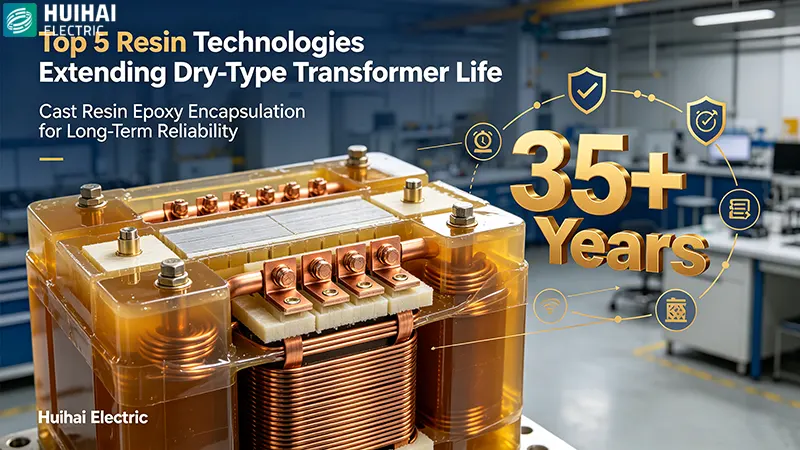
Technology 1: Full-Vacuum Epoxy Resin Casting
At the foundation of long-life dry-type transformers is full-vacuum epoxy resin casting—a process that transforms windings into a solid, void-free, completely encapsulated block.
How It Works
Windings are preheated and dried in a vacuum environment, then resin is injected under continuous vacuum to ensure complete penetration between every turn of the winding. The result? A homogeneous insulation structure with virtually no air gaps.
Why It Extends Life
Partial discharge (PD) is the primary cause of insulation aging and eventual breakdown. Micro-voids, cracks, or filler-resin interface defects become PD sources under operating voltage, generating high-energy particle bombardment that erodes insulation.
Full-vacuum casting eliminates these voids. Factory PD levels are kept extremely low—typically below 10 pC—cutting off the insulation degradation pathway at the source and significantly extending electrical service life.
Lifespan impact: Transformers using high-quality vacuum cast resin technology are "sealed for life (>30 years)". Under rated load, a 30-year standard lifespan depends on the absence of internal partial discharge.
Technology 2: Glass Fiber Reinforcement
Pure resin alone is not enough. The integration of glass fiber reinforcement represents a quantum leap in mechanical durability and thermal cycling resistance.
How It Works
The RESIBLOC technology, pioneered in 1974, uses epoxy resin with a high content of glass fiber to encapsulate transformer windings. This creates a solid, homogeneous insulation structure that provides superior mechanical strength, thermal stability, and moisture resistance. Today, over 70,000 units using this technology are installed in more than 120 countries.
Why It Extends Life
Transformers experience constant thermal cycling—heat during operation, cooling during shutdown, and mechanical vibration during handling. Repeated expansion and contraction stress the cured resin. Without reinforcement, micro-cracks develop on coil surfaces and eventually propagate into through-cracks.
Glass fiber reinforcement solves this. The "thin insulation" structure gives the resin layer sufficient elasticity to expand and contract with the winding without cracking. The result is a transformer exceptionally resistant to thermal cycling cracking.
Lifespan impact: Some customers report RESIBLOC units running fully operational over 20 years without any issues. The technology has been proven across five decades of continuous evolution.
Technology 3: Advanced Epoxy Formulations with Thermal Fillers
The epoxy resin itself has evolved dramatically. Modern formulations integrate thermally conductive fillers that solve the historic trade-off between insulation and heat dissipation.
How It Works
By embedding thermally conductive yet electrically inert particulates—such as surface-treated alumina, typically 60-70% by weight—manufacturers create a composite material that channels heat away from copper windings while maintaining insulation thresholds exceeding 30 kV/mm.
Modern halogen-free formulations now meet IEC 60085 thermal class 180 requirements. The resin's coefficient of thermal expansion is carefully engineered to match copper's 17 ppm/°C, minimizing interfacial stresses during load fluctuations.
Why It Extends Life
Heat is the enemy of insulation life. Advanced epoxy formulations dissipate heat more effectively, keeping winding temperatures lower under the same load conditions. This directly translates to longer insulation life—and the coefficient matching prevents the micro-gaps that become moisture migration pathways in humid environments.
Lifespan impact: Advances in epoxy formulations have improved dielectric strength and thermal conductivity, enabling more compact designs without compromising performance.
Technology 4: Toughened Resin Systems with Stress-Managed Curing
Even the best resin can fail if internal stresses are not managed during curing. Toughened resin systems combined with programmed curing profiles address this critical vulnerability.
How It Works
Toughening agents are added to the epoxy formulation, and a programmed temperature-controlled curing curve allows slow, uniform solidification to minimize residual internal stress. This "material + process" synergy gives the transformer exceptional resistance to thermal cycling cracking.
Why It Extends Life
Without proper stress management, the cured epoxy resin layer develops internal stress that can lead to micro-cracks after a certain number of thermal cycles. These micro-cracks grow with each thermal cycle, eventually compromising insulation integrity.
Proper stress management prevents this progressive degradation. The insulation remains intact through decades of thermal cycling, maintaining its dielectric strength throughout the transformer's service life.
Lifespan impact: Under normal use conditions, high-quality cast resin transformers with proper stress management will not develop coil surface cracking due to temperature changes within their rated service life.
Technology 5: Next-Generation Materials — Nano-Modified and Eco-Friendly Resins
The frontier of transformer resin technology is moving toward nano-modified composites and sustainable formulations.
Nano-Modified Resins
Research shows that adding small amounts of h-boron nitride (BN) and Al₂O₃ can improve the thermal stability of composite insulation materials. Nanoparticles enhance thermal conductivity, mechanical strength, and electrical insulation simultaneously—without the weight penalties of conventional fillers.
Future developments are focusing on nanotechnology-enabled resin formulations to further extend transformer life and enable higher power densities.
Eco-Friendly and Degradable Resins
Traditional epoxy resins face challenges in degradation and recycling. New research is synthesizing highly degradable epoxy resins based on ester exchange reactions. The development of bio-based or biodegradable epoxy resins aims to reduce the environmental burden throughout the product lifecycle.
Why It Matters
Nano-modified resins offer enhanced mechanical strength, improved thermal conductivity, and superior dielectric properties—all in a more compact form factor. Eco-friendly resins address end-of-life disposal concerns while maintaining the performance characteristics required for long-life transformer operation.
Future outlook: These next-generation materials are expected to push dry-type transformer service life beyond 40 years while reducing environmental impact.
Comparison: Cast Resin vs. VPI — Why Technology Choice Matters
To understand the impact of resin technology, compare cast resin transformers with VPI (Vacuum Pressure Impregnated) alternatives:
| Feature | Cast Resin (CRT) | VPI Transformer |
| Encapsulation | Fully sealed solid block | Varnish-impregnated, open structure |
| Moisture Protection | Excellent — impervious to moisture | Moderate — can absorb moisture in humid conditions |
| Mechanical Strength | Very high — superior short-circuit resistance | Moderate |
| Typical Service Life | 25–30+ years | 20–25 years |
| Harsh Environment Suitability | Excellent | Limited |
| Repairability | Not repairable — coil replacement required | Sometimes repairable |
In high-humidity, high-salinity, and heavily polluted environments, cast resin transformers generally provide stronger protection and reliability.
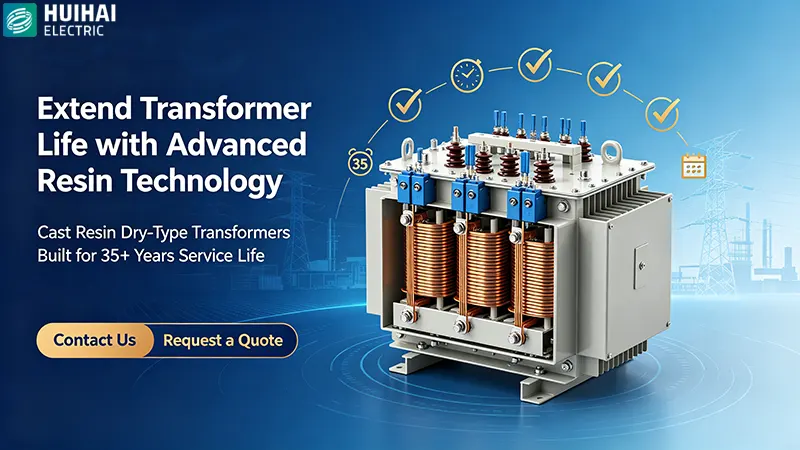
How These Technologies Work Together
These five technologies are not isolated innovations—they work in synergy:
- Full-vacuum casting eliminates PD-causing voids (Technology 1)
- Glass fiber reinforcement prevents thermal cycling cracks (Technology 2)
- Advanced thermal fillers keep temperatures lower, slowing aging (Technology 3)
- Stress-managed curing prevents internal stress fractures (Technology 4)
- Nano and eco-friendly materials extend the frontier further (Technology 5)
The result is a transformer that can reliably serve beyond 35 years—even in demanding environments.
Why Huihai Electric Employs These Advanced Resin Technologies
At Huihai Electric, we understand that transformer longevity is not accidental—it is engineered. Our dry-type transformers incorporate:
- Full-vacuum epoxy casting with rigorous PD control below 10 pC
- Glass fiber reinforcement for exceptional mechanical strength and thermal cycling resistance
- Advanced epoxy formulations with optimized thermal management
- Precision curing profiles to minimize internal stress
- Compliance with IEC 60076-11, IEEE C57.12.01, and GB/T 10228-2025 standards
Whether your application is a coastal substation, an industrial facility, or a renewable energy project, Huihai Electric delivers dry-type transformers engineered for the long haul—35 years and beyond.
Written by
Huihai Electric Co., Ltd.
Editor Xu
www.huihai-electric.com
WhatsApp:+86 139 1136 0187
Email:info@huihai-electric.com
- 7 Reasons Dry-Type Transformers Are Replacing Oil-Filled Units in 2026 Smart Grid Projects
- 9 Important Considerations for Outdoor Installation of Power Transformers
- Top 5 Digitalization Trends in Dry-Type Transformers: Smart Sensors & Predictive Maintenance
- 6 Advantages of Prefabricated Substations Over Traditional Stick-Built Designs
HUIHAIElectric
Huihai Electric is a leading manufacturer of smart grid equipment in China.