Huihai
Electric
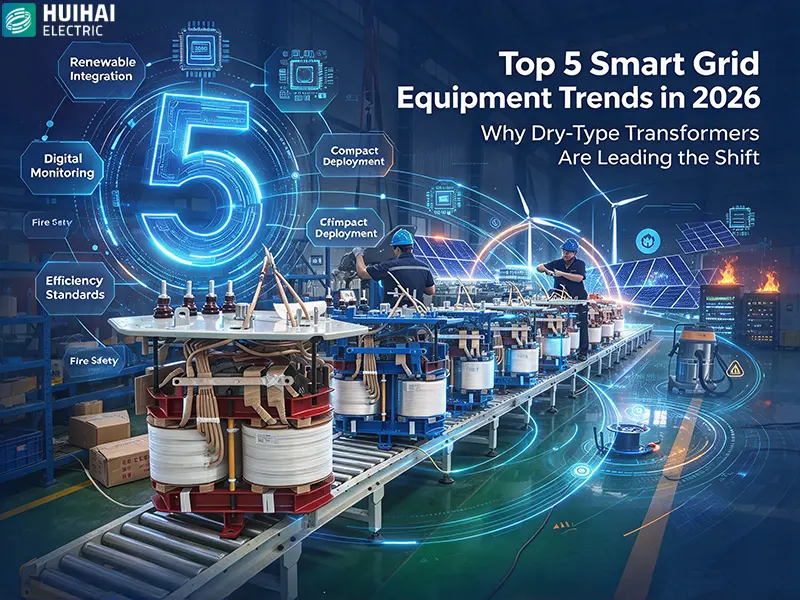
Top 5 Smart Grid Equipment Trends in 2026: Why Dry-Type Transformers Are Leading the Shift
The smart grid is no longer a future concept. It is the operating reality that utilities, industrial operators, and commercial developers are building today. What distinguishes a smart grid from a conventional one is not simply the presence of digital meters—it is the expectation of bidirectional power flow, high penetration of distributed energy resources, real-time asset visibility, and automated fault response.
In this environment, every piece of equipment in the distribution chain is being re-evaluated against new criteria. Dry-type transformers, once considered a niche alternative to oil-filled units, are now at the center of this re-evaluation. The global dry-type transformer market grew from USD 7.1 billion in 2025 to USD 7.66 billion in 2026 at a CAGR of 7.9%, and is projected to reach USD 10.26 billion by 2030. Different market assessments place the 2026 figure between USD 7.66 billion and USD 18.37 billion depending on scope, but the direction is consistent across sources: demand is accelerating.
This article examines the top 5 smart grid equipment trends shaping 2026, and explains why dry-type transformers are leading the shift in each one.
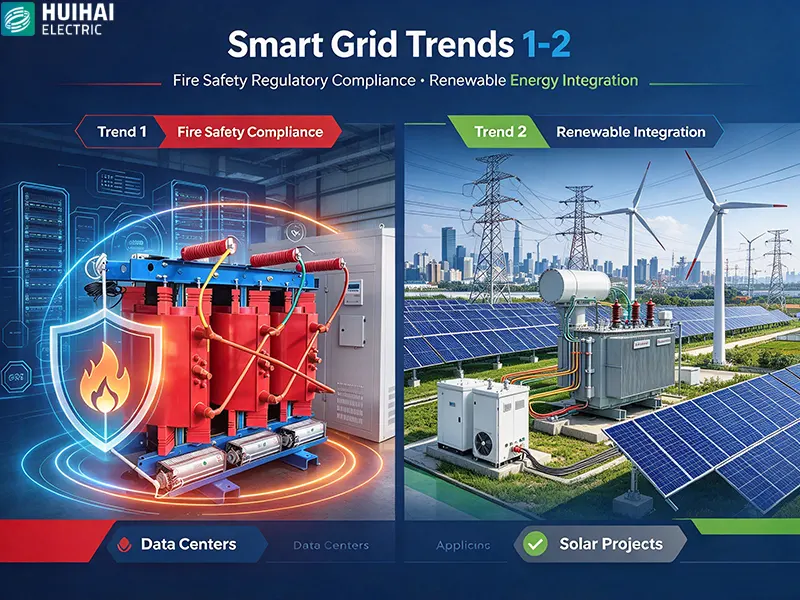
Trend 1: Fire Safety and Regulatory Compliance Are Becoming Non-Negotiable
Trend indicator: Fire safety codes and environmental regulations are converging to make oil-filled transformers increasingly difficult to justify in urban, indoor, and sensitive installations.
The first trend is not a technology trend in the conventional sense—it is a regulatory and risk-management trend that is reshaping equipment selection across every smart grid project. Fire safety codes and environmental regulations are converging to make oil-filled transformers increasingly difficult to justify in urban, indoor, and sensitive installations.
The Regulatory Pressure Is Structural
National electrical safety codes in major markets now mandate fire safety and oil containment measures that structurally favor dry-type designs. China's GB 50054 and India's Indian Electricity Rules both impose requirements that make dry-type air-insulated transformers the practical choice for buildings, underground substations, and densely populated areas. In parallel, the phase-out of SF₆ under the EU F-Gas Regulation and similar initiatives in Japan and South Korea is pushing utilities toward air-insulated and dry-type alternatives.
The regulatory trend across Asia is clearly toward stricter environmental and safety standards, and this structurally benefits air-insulated and dry-type transformer adoption over the forecast period. In Europe, stringent regulatory frameworks including the EU Green Deal and Eco-design Directive emphasize carbon footprint reduction and energy conservation, reinforcing the shift toward dry-type and eco-friendly transformer designs.
Why Dry-Type Transformers Are Leading
Dry-type transformers eliminate the flammable oil that is the root cause of fire risk in conventional units. They also eliminate the risk of oil spills that can contaminate soil and groundwater. For smart grid projects that are increasingly subject to ESG reporting requirements and environmental impact assessments, this is not a secondary consideration—it is a qualification criterion.
In data centers, hospitals, high-rise buildings, and underground substations, the fire safety advantage of dry-type transformers is decisive. Data center operators increasingly specify dry-type cast resin transformers with IoT-enabled condition monitoring and partial discharge sensors, not only for safety but because these features align with the operational requirements of mission-critical facilities.
Trend 2: Renewable Energy and Data Center Demand Is Reshaping the Load Profile
Trend indicator: Smart grids must accommodate reverse power flow from solar, pulsed demand from EV chargers, and bidirectional energy flows from battery storage.
The second trend is the transformation of the load profile that distribution transformers must serve. Smart grids are no longer designed primarily for unidirectional power flow from transmission to load. They must accommodate reverse power flow from rooftop solar, pulsed demand from electric vehicle fast chargers, and bidirectional energy flows from battery storage.
The Renewable Integration Driver
The expansion of renewable energy infrastructure is a direct driver of dry-type transformer demand. Dry-type transformers play a key role in supporting renewable energy systems by enabling the safe and efficient integration of wind and solar power into the grid, offering low maintenance, minimal fire risk, and improved environmental sustainability. Renewable energy projects often require transformers that can handle harmonics, frequent load cycling, and reversible power flow—characteristics that modern dry-type designs are engineered to manage.
The growth in forecast-period dry-type transformer demand is attributed in part to growth in renewable power integration, increasing electrification of public infrastructure, rising demand for compact substation solutions, expansion of smart grid networks, and stricter fire safety and environmental standards.
The Data Center and EV Factor
Beyond renewables, two additional load types are reshaping demand. Hyperscale data centers represent a significant demand vector, reflecting the growth of the digital economy and the need for uninterrupted power supply. The expanding electrification of transportation, including EV charging infrastructure, further amplifies transformer capacity requirements.
Dry-type transformers are particularly well-suited to these applications. Their fire safety makes them preferable for indoor data center installations. Their compact footprint and low maintenance requirements align with the operational priorities of commercial and industrial facilities. The penetration of dry-type transformers in data centers, commercial buildings, and offshore wind applications climbed from 28% in 2020 to 39% in 2026. In urban data centers, high-rise buildings, and rail transit, the application share reached 42%.
Why Dry-Type Transformers Are Leading
Oil-filled transformers were designed for steady, predictable loads. They are thermally robust, but they are not optimized for the cyclic and harmonic-rich loading that renewable generation and EV charging impose. Dry-type transformers, particularly cast-resin designs, offer thermal cycling tolerance and compatibility with the harmonic environments created by inverters and power electronics. As the load profile of the smart grid evolves, dry-type designs are better matched to the duty cycle.
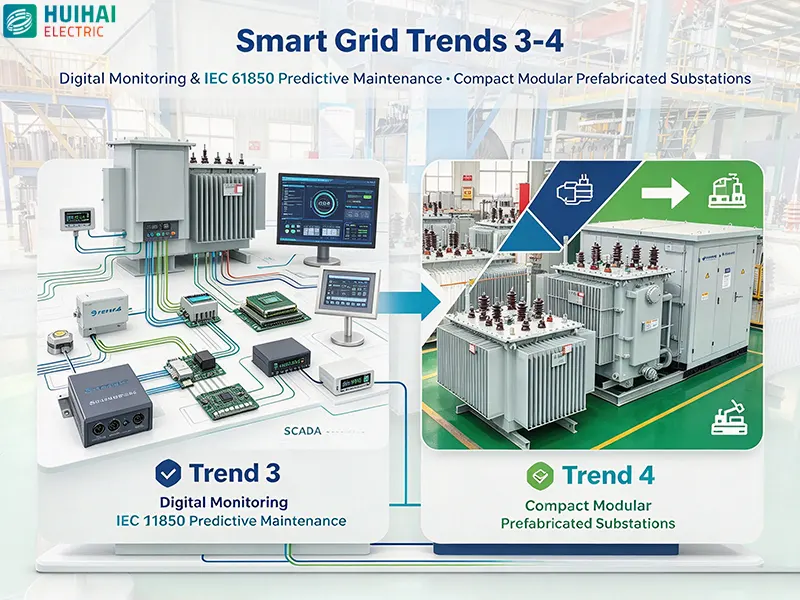
Trend 3: Digitalization and Predictive Maintenance Are Moving from Optional to Baseline
Trend indicator: Smart grids require equipment that can generate, transmit, and act on operational data—not just equipment that performs its electrical function.
The third trend is the digitalization of distribution equipment. Smart grids are data-driven grids, and equipment that cannot generate, transmit, and act on operational data is increasingly an outlier in the architecture.
The Smart Transformer Concept Is Maturing
The smart transformer concept involves integrating sensors for continuous condition monitoring of parameters including temperature, partial discharge, and load profile. This data enables predictive maintenance, moving from time-based to condition-based servicing, which reduces unplanned outages and extends asset life.
Digitalization and smart grid deployment are accelerating the adoption of intelligent transformers integrated with IoT and AI capabilities, enabling real-time performance monitoring. Advanced transformers with these capabilities not only improve operational efficiency but also facilitate the accommodation of decentralized and intermittent renewable energy sources.
The Market Is Confirming the Shift
Smart-connected transformers with embedded monitoring and communication capabilities are forecast to grow from less than 10% to 25–30% of market value by 2035, driven by utility digitalization programs and operator demand for predictive maintenance. The smart transformers market overall is growing faster than the conventional transformer market, projected to expand from USD 4.4 billion in 2026 to USD 8.81 billion by 2031.
Why Dry-Type Transformers Are Leading
Dry-type transformers are inherently more compatible with embedded sensing than oil-filled units. Cast-resin designs allow sensors to be placed in close proximity to windings without the complications of oil-tight sealing. Fiber-optic temperature sensors can be embedded directly in the cast resin during manufacture, providing hotspot data that is more accurate than external thermal measurements. Partial discharge sensors can be integrated into the enclosure without compromising the oil containment integrity that oil-filled units require.
For smart grid operators, the digital interface is not an add-on—it is the mechanism through which the transformer participates in grid operations. Dry-type transformers that are designed for digital integration from the factory floor are better positioned to serve this role than conventional units that require retrofitting.
Trend 4: Compact and Modular Deployment Is Reshaping Urban Grid Architecture
Trend indicator: Prefabricated and modular substations are enabling smart grid deployment in space-constrained urban environments, with dry-type transformers as the natural enabler.
The fourth trend is the shift toward compact, modular, and prefabricated deployment models. Smart grids are being built in the places where space is scarcest: dense urban centers, commercial districts, and industrial parks. Traditional stick-built substations with their extensive footprints and long construction timelines are increasingly incompatible with these locations.
The Space Constraint Is Real
Compact substation solutions are in demand because urban land is expensive and scarce. Prefabricated cabin substations can reduce land occupation by 30–70% compared to conventional designs, while also delivering 5–10% lower project cost and a shorter construction period. Some compact designs reduce the footprint of the substation enclosure by 30% or more through optimized layout.
The global modular prefabricated cabin substation market reflects this demand: it was valued at USD 2.17 billion in 2025 and is forecast to reach USD 4.01 billion by 2032 at a CAGR of 8.8%. The broader modular substation market is growing from USD 24.79 billion in 2026 to USD 45.22 billion by 2034 at 7.8% CAGR.
Why Dry-Type Transformers Are Leading
Dry-type transformers are the natural partner for compact and prefabricated substation architectures. Because they do not require oil containment vaults, fire separation distances, or complex ventilation for oil cooling, they can be integrated more densely into modular enclosures. This enables the space savings that prefabricated substation designs deliver.
The trend toward indoor and underground substation installations is explicitly identified as a driver of dry-type transformer demand. In urban environments where substations must be integrated into buildings, parking structures, or underground spaces, the absence of oil is not a convenience—it is a design enabler.
Trend 5: Efficiency Standards and Environmental Performance Are Tightening
Trend indicator: Efficiency standards and environmental compliance requirements are tightening, and dry-type transformers are meeting both challenges simultaneously.
The fifth trend is the tightening of efficiency standards and environmental performance requirements. Smart grids are expected to deliver more power with fewer losses, and the equipment within them must contribute to that objective.
Efficiency Is Improving Rapidly
Modern dry-type transformer designs have closed much of the efficiency gap with oil-filled units. SCB13 series dry-type transformers achieve approximately 98.7% efficiency under IEC 60076-11 testing. Higher-specification cast resin designs achieve efficiency in the range of 96.9% to 99.1% at full load and 0.8 power factor, depending on rating.
The efficiency improvement is not marginal. Dry-type transformer no-load losses have fallen by approximately 15–20% relative to older standards, driven by better core materials and manufacturing processes. As efficiency standards continue to tighten, the dry-type segment is keeping pace.
Environmental Compliance Is a Moving Target
The dry-type transformer market is increasingly shaped by environmental compliance requirements. REACH and RoHS compliance is increasingly required for materials used in transformer insulation and coatings, particularly for units exported to or specified by multinational buyers. The shift away from SF₆ and other fluorinated gases is creating substitution opportunities for air-insulated and dry-type designs across medium- and high-voltage applications.
Dry-type transformers also align with circular economy objectives. They eliminate the need for oil handling, testing, and disposal over the equipment's lifecycle. At end-of-life, the copper and steel in dry-type transformers can be recovered without the contamination concerns associated with oil-impregnated materials.
Why Dry-Type Transformers Are Leading
Efficiency and environmental performance are no longer secondary considerations in smart grid procurement. They are primary selection criteria, driven by both economics and regulation. Dry-type transformers are meeting the efficiency challenge while simultaneously eliminating the environmental liabilities of oil-filled designs. For projects that must satisfy both efficiency standards and environmental compliance, dry-type transformers offer a single solution to two converging requirements.
What This Means for Procurement in 2026
The five trends described above converge on a clear conclusion: dry-type transformers are not simply one option among many for smart grid projects. They are increasingly the default choice for applications where fire safety, space constraints, digital integration, renewable compatibility, or environmental compliance are priorities.
For procurement teams specifying dry-type transformers in 2026, the technical parameters that matter most are aligned with these trends:
| Parameter | What to Verify | Trend Alignment |
|---|---|---|
| Fire safety classification | F1 per IEC 60076-11; restricted flammability appropriate for installation environment | Trend 1: Fire safety and regulatory compliance |
| Environmental and climate classification | E2/C2 ratings for humidity, pollution, and temperature conditions at site | Trend 1: Regulatory compliance |
| Partial discharge performance | Low PD at factory (≤10 pC at 1.3× rated voltage; high-quality units <5 pC) | Trend 3: Digital monitoring and reliability |
| Digital interface readiness | IEC 61850 support; sensor interfaces for temperature and partial discharge | Trend 3: Digitalization and predictive maintenance |
| Efficiency certification | Validated against IEC 60076-11 or regional standard with accredited test reports | Trend 5: Efficiency standards |
| Footprint and modularity | Compact design suitable for prefabricated substation integration | Trend 4: Compact and modular deployment |
How Huihai Electric Supports the Dry-Type Shift
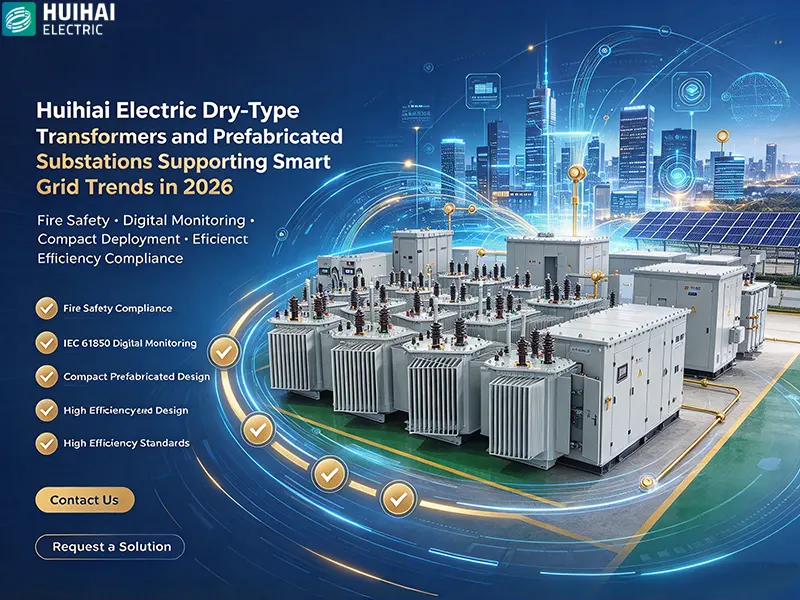
Huihai Electric manufactures dry-type transformers and prefabricated substation equipment designed for the technical requirements that smart grid projects impose. The company's product portfolio addresses the trends described in this article across several dimensions.
On fire safety and environmental compliance, Huihai Electric's cast-resin dry-type transformers are designed to meet F1 fire classification and E2/C2 environmental classifications under IEC 60076-11, with full type test documentation. On digital readiness, the company's dry-type transformer platforms are designed for integration with monitoring and communication systems, supporting condition data availability for SCADA and asset management architectures. On compact deployment, Huihai Electric's prefabricated substation solutions integrate dry-type transformers into modular enclosures that reduce footprint and construction time.
Huihai Electric's dry-type transformers are manufactured under ISO 9001 quality management and ISO 14001 environmental management systems, with type test reports from accredited laboratories. For smart grid projects where dry-type transformers must satisfy both electrical performance requirements and the broader trends of fire safety, digitalization, efficiency, and environmental compliance, Huihai Electric provides a documented and application-focused solution.
Conclusion
The smart grid equipment trends of 2026 are not abstract market movements. They are the operational and regulatory realities that are determining which technologies succeed in the field. Fire safety codes, renewable integration, digital monitoring, space constraints, and efficiency standards are each pushing the distribution transformer market in the same direction: toward dry-type designs.
Dry-type transformers are leading the shift because they are the technology that best matches the requirements of the smart grid environment. They eliminate the fire and environmental liabilities of oil. They are compatible with embedded sensing and digital communication. They fit into compact, modular deployment models. And they meet the efficiency and environmental performance standards that regulators and project owners are increasingly demanding.
For utilities, EPC contractors, and industrial developers planning smart grid projects in 2026 and beyond, the dry-type transformer is not simply an alternative to be considered. It is the equipment category that is structurally aligned with where the grid is heading.
Ready to specify dry-type transformers for your smart grid project?
Contact Huihai Electric to discuss your voltage class, kVA rating, environmental classification, and digital interface requirements, or request technical documentation for evaluation.
Huihai Electric Co., Ltd.
Editor Xu
WhatsApp:+86 139 1136 0187
Email:info@huihai-electric.com
HUIHAIElectric
Huihai Electric is a leading manufacturer of smart grid equipment in China.