Huihai
Electric
Avoid Costly Mistakes: 8 Dry-Type Transformer Specs to Verify Before Purchase
Avoid costly procurement mistakes with this checklist of 8 critical dry-type transformer specifications. Essential reading for industrial buyers, procurement managers, and project engineers.
Purchasing a dry-type transformer for an industrial application is a significant investment—often exceeding $50,000 to $500,000+ depending on rating and complexity. A wrong specification can lead to catastrophic failures, unplanned downtime, safety hazards, and millions of dollars in operational losses.
Yet many procurement teams and project engineers rush through the specification review process, focusing on price and delivery while overlooking critical technical parameters that determine long-term reliability and performance.
This guide covers 8 essential specifications you must verify before signing a purchase order—each one validated against IEC 60076-11, IEEE C57.12.01, and other international standards, ensuring your transformer delivers decades of safe, reliable service.
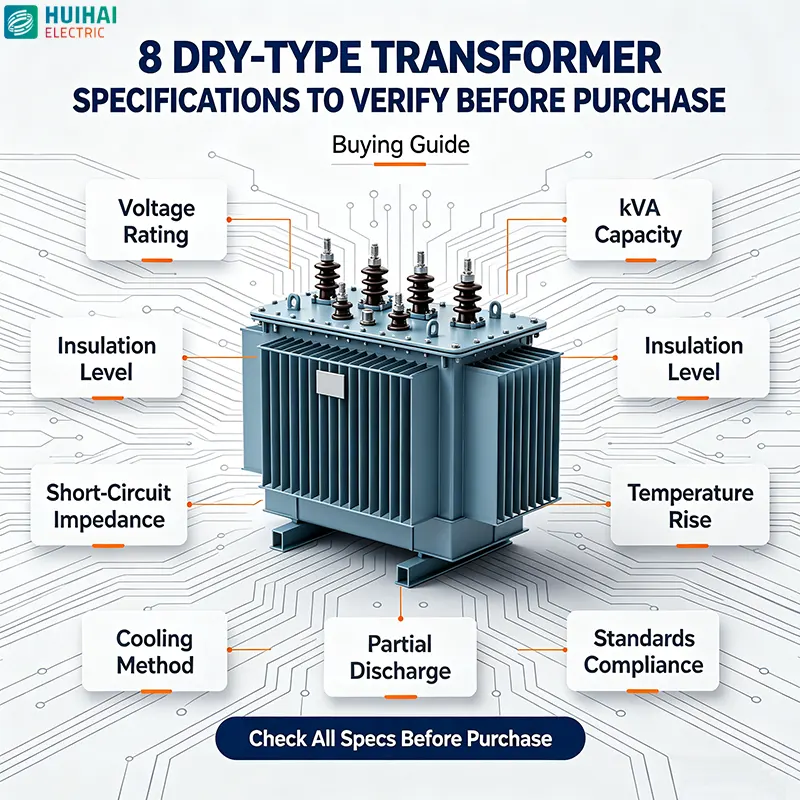
Spec 1: Rated Voltage and Voltage Class
The transformer's rated voltage must match your system's primary and secondary voltage levels. This seems obvious, but voltage class selection has far-reaching implications for insulation design, clearance distances, and overall cost.
What to Verify:
- Primary rated voltage (e.g., 11 kV, 33 kV, 66 kV)
- Secondary rated voltage (e.g., 400 V, 3.3 kV, 6.6 kV, 11 kV)
- Voltage class (e.g., 12 kV, 24 kV, 36 kV for medium voltage)
- Tapping range (e.g., ±2×2.5% on primary for voltage regulation)
Why It Matters:
A transformer designed for a lower voltage class will have insufficient insulation levels, risking breakdown and failure. Overspecifying voltage class adds unnecessary cost without benefit.
Red Flags:
- Supplier doesn't clearly state the voltage class on the datasheet
- Tapping range insufficient for your expected voltage fluctuations
- Insulation level not specified for your system's overvoltage conditions
Questions to Ask:
What voltage class is this transformer designed for, and what are the rated power frequency and lightning impulse withstand voltages?
Spec 2: kVA Rating and Overload Capability
The transformer's rated power (kVA) must comfortably handle your connected load—including peak demands and future expansion.
What to Verify:
- Rated kVA (continuous capacity at specified ambient temperature)
- Overload capability (percentage of rated load for emergency conditions)
- Load profile (steady vs. cyclic loads)
- Future expansion allowance (typically 15–25% margin)
Why It Matters:
The kVA rating determines the transformer's ability to deliver power without exceeding temperature limits. Undersizing leads to premature aging and failure; oversizing wastes capital and increases no-load losses.
Real-World Impact:
A 2000 kVA transformer operating at 110% of rated load continuously may see its insulation life reduced by 80% or more, per the Arrhenius aging model (every 10°C rise halves life).
Questions to Ask:
What is the continuous kVA rating, and what overload capability can the transformer sustain for 1 hour, 2 hours, and emergency conditions?
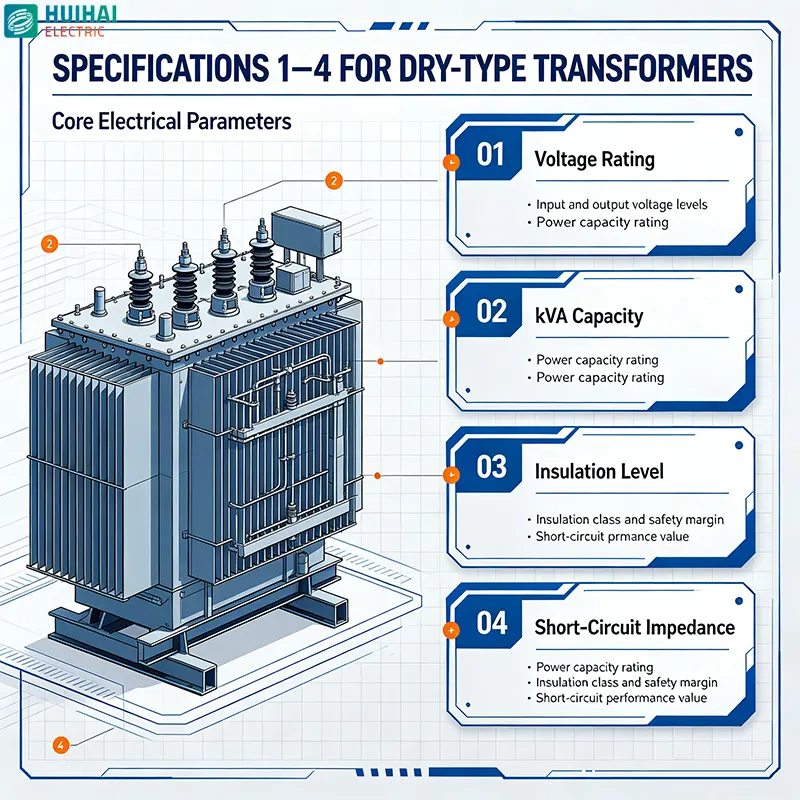
Spec 3: Insulation Level — BIL and Power Frequency Withstand
Insulation level defines the transformer's ability to withstand transient overvoltages (lightning strikes, switching surges) and power frequency voltage stress.
What to Verify:
- Basic Lightning Impulse Insulation Level (BIL) — typically expressed as peak kV (e.g., 75 kV, 95 kV, 125 kV for 12–36 kV systems)
- Power frequency withstand voltage — typically expressed as RMS kV for 1 minute (e.g., 28 kV, 35 kV, 50 kV)
- Altitude correction factor (for installations above 1,000 m)
Why It Matters:
Inadequate BIL means the transformer is vulnerable to surge damage. In areas with high lightning activity or switching surges, under-specified insulation is a recipe for early failure.
Typical BIL Values (IEC 60076-11):
| System Voltage (kV) | Rated BIL (kV peak) | Power Frequency Withstand (kV RMS) |
| 3.6 | 40 | 10 |
| 7.2 | 60 | 20 |
| 12 | 75 | 28 |
| 17.5 | 95 | 38 |
| 24 | 125 | 50 |
| 36 | 170 | 70 |
Questions to Ask:
What is the BIL level and power frequency withstand voltage for this transformer? Are the test values derated for our installation altitude?
Spec 4: Short-Circuit Impedance (%Z)
Short-circuit impedance, expressed as a percentage (%Z), determines the transformer's voltage regulation and the magnitude of fault currents that the transformer can withstand.
What to Verify:
- %Z at rated current and frequency (typically 4–8% for distribution transformers, 8–12% for larger units)
- Tolerance (typically ±10% for standard designs)
- Short-circuit withstand capability (thermal and dynamic)
Why It Matters:
- Low %Z = better voltage regulation, but higher fault currents
- High %Z = lower fault currents (beneficial for switchgear rating), but poorer regulation
Application Guidelines:
| Application | Recommended %Z | Reason |
| Distribution (urban) | 4–6% | Good regulation, moderate fault current |
| Distribution (rural) | 6–8% | Larger fault current tolerance |
| Industrial with large motors | 6–8% | Reduced voltage dip during motor starting |
| Generator step-up | 10–15% | Fault current limitation for generator |
Questions to Ask:
What is the guaranteed short-circuit impedance at rated temperature? What is the tolerance band?
Spec 5: Temperature Rise Limits
Temperature rise directly affects transformer life. Every 10°C above rated temperature halves the insulation life (Arrhenius rule).
What to Verify:
- Winding temperature rise (typically 65°C or 80°C for Class F/H insulation)
- Hot-spot temperature rise
- Top oil / core temperature rise
- Ambient temperature rating (typically 40°C average, 55°C maximum)
- Average winding temperature rise — the average temperature increase above ambient during continuous rated operation
Industry Benchmarks (Per IEC/IEEE):
| Parameter | Limit (IEC) | Limit (IEEE) |
| Winding average (Class A) | 65°C | 65°C |
| Winding average (Class F) | 100°C | 115°C |
| Hot-spot temperature | ≤ 140°C | ≤ 150°C |
| Core temperature rise | ≤ 80°C | ≤ 100°C |
Why It Matters:
Transformers that run hot age faster. A 10°C reduction in operating temperature can double transformer life. Verify that the manufacturer's temperature rise tests are conducted at your site's maximum ambient temperature.
Questions to Ask:
What is the guaranteed average and hot-spot temperature rise at rated load and 40°C ambient? Are there derating requirements for higher ambient temperatures?
Spec 6: Cooling Method — AN, AF, or AN/AF
The cooling method determines how the transformer dissipates heat and affects its continuous rating, overload capability, and footprint.
Common Cooling Classes (IEC 60076-11):
| Code | Meaning | Application |
| AN | Air Natural (natural convection) | Standard indoor applications, no fans, 100% capacity |
| AF | Air Forced (forced air via fans) | Higher capacity in same footprint, fan-assisted cooling |
| AN/AF | Dual rating (natural + forced) | Full capacity with fans, derated without |
Why It Matters:
- AN only: Simpler, lower maintenance, lower cost, but larger for a given rating
- AF or AN/AF: More compact for the same kVA, but requires fan maintenance and power supply
Key Insight:
When airflow is obstructed, a transformer's rating can be reduced by up to 30%. Ensure your installation environment allows adequate ventilation for the specified cooling method.
Questions to Ask:
What is the cooling class of this transformer? What is the derating factor if we specify a smaller enclosure or if ambient temperature exceeds 40°C?
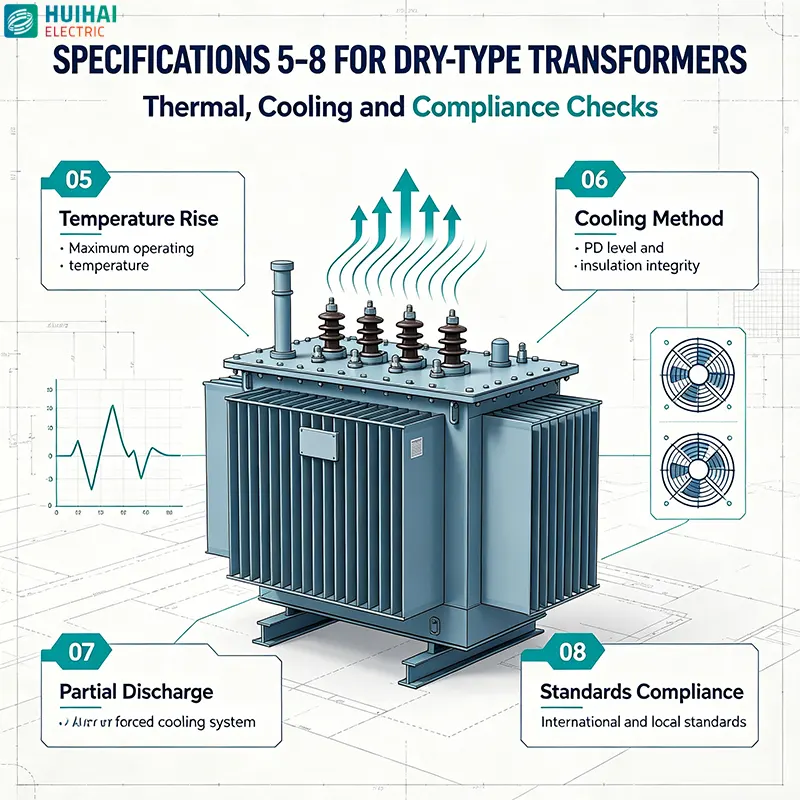
Spec 7: Partial Discharge (PD) Level
Partial discharge (PD) is one of the most sensitive indicators of insulation quality and long-term reliability. High PD levels suggest manufacturing defects—voids, cracks, or contamination—that will worsen over time.
What to Verify:
- PD level at 1.1× rated voltage (measured in picocoulombs, pC)
- PD extinction voltage (the voltage at which PD ceases)
- Test method (IEC 60270)
- Guaranteed maximum PD level over the transformer's lifetime
Industry Benchmarks:
| Voltage Level | Acceptable PD Level (pC) | Excellent PD Level (pC) |
| ≤ 12 kV | ≤ 10 pC | ≤ 5 pC |
| 24–36 kV | ≤ 10 pC | ≤ 5 pC |
| ≥ 72.5 kV | ≤ 10 pC | ≤ 5 pC |
Why It Matters:
A transformer with 20 pC PD at factory testing will likely see that number rise to 50+ pC within 5 years of service. At 100 pC, insulation degradation accelerates rapidly, leading to failure within 1–2 years.
Red Flags:
- Manufacturer cannot provide PD test reports from independent labs
- PD level is guaranteed only at 1.0× voltage (not 1.1×)
- Test voltage is not stated clearly
Questions to Ask:
What is the guaranteed partial discharge level at 1.1× rated voltage? Can you provide the PD test report for this specific unit?
Spec 8: Standards Compliance and Type Test Reports
Compliance with international standards is the foundation of transformer quality. It ensures safety, performance, and interoperability.
What to Verify:
- IEC 60076-11 (Dry-type power transformers)
- IEEE C57.12.01 (Dry-type distribution transformers)
- IEEE C57.12.91 (Test code)
- GB/T 10228 (Chinese standard for dry-type transformers)
- ISO 9001 (Quality management)
- ISO 14001 (Environmental management)
Required Type Test Reports (IEC 60076-11):
| Test | Purpose |
| Temperature rise test | Verifies cooling performance |
| Lightning impulse test | Verifies BIL withstand |
| Power frequency withstand test | Verifies insulation integrity |
| Short-circuit test | Verifies dynamic and thermal withstand |
| Partial discharge test | Verifies insulation quality |
Why It Matters:
Transformers without complete type test reports are effectively unproven. Many suppliers offer "type tested" designs but cannot provide the actual test reports—or conduct tests only on smaller units and extrapolate.
Red Flags:
- Supplier only offers "design type tested" without certified reports
- Test reports are from non-accredited laboratories
- Reports are over 5 years old or for a different design
- Supplier hesitates to share test documentation
Questions to Ask:
Can you provide complete type test reports from an accredited independent laboratory for this exact design and rating? May we review the reports before placing the order?
Summary: Your 8-Point Dry-Type Transformer Specification Checklist
| No. | Specification | Key Verification Point |
| 1 | Rated Voltage | Primary/secondary voltage + voltage class + tapping range |
| 2 | kVA Rating | Continuous rating + overload capability + future margin |
| 3 | Insulation Level | BIL + power frequency withstand + altitude correction |
| 4 | Short-Circuit Impedance (%Z) | %Z value + tolerance + fault current implications |
| 5 | Temperature Rise | Winding average + hot-spot + ambient derating |
| 6 | Cooling Method | AN / AF / AN/AF + derating for restricted airflow |
| 7 | Partial Discharge Level | PD at 1.1× voltage + extinction voltage + test method |
| 8 | Standards Compliance | IEC/IEEE/GB + type test reports from accredited labs |
Why Huihai Electric Meets All 8 Specifications
At Huihai Electric, we understand that transformer procurement is a high-stakes decision. Our dry-type transformers are designed and manufactured to the highest international standards, with complete documentation for every unit.
What you get with Huihai Electric:
- Full IEC/IEEE compliance with type test reports from accredited laboratories
- Guaranteed PD levels ≤ 5 pC at 1.1× rated voltage
- Conservative temperature rise designs with generous safety margins
- Complete documentation including test reports, drawings, and manuals
- Customizable ratings to match your specific voltage, kVA, and impedance requirements
Whether you are upgrading industrial power distribution, expanding a data center, or integrating renewable energy, Huihai Electric delivers dry-type transformers you can rely on—backed by rigorous quality control and decades of manufacturing expertise.
Written by
Huihai Electric Co., Ltd.
Editor Xu
www.huihai-electric.com
WhatsApp:+86 139 1136 0187
Email:info@huihai-electric.com
- The 9 Key Roles of Dry-Type Transformers in Modern Smart Grid Infrastructure Construction
- The 9 Core Roles of Huihai Electric Prefabricated Substations in Photovoltaic Power Generation Systems
- High Voltage Switchgear Installation Guide: 10 Steps for Safe and Reliable Commissioning
- High Voltage Switchgear Supplier Evaluation: 6 Critical Quality KPIs for B2B Buyers
HUIHAIElectric
Huihai Electric is a leading manufacturer of smart grid equipment in China.