Huihai
Electric
Top 5 Ways Box-Type Substations Cut On-Site Construction Time by 60% in 2026
Construction schedules in the power distribution industry are under relentless pressure. Utilities, industrial developers, and renewable energy project owners are being asked to deliver grid connections faster than ever—while maintaining safety, quality, and regulatory compliance. Traditional stick-built substations, with their 12-to-18-month timelines and extensive on-site labor requirements, simply cannot keep pace.
The solution that is reshaping project delivery in 2026 is the box-type substation. These factory-built, modular power distribution units integrate transformers, switchgear, protection systems, and control equipment into a single compact enclosure—dramatically reducing on-site construction time by up to 60%.
The global box-type substation market was valued at USD 19.16 billion in 2025 and is projected to reach USD 32.00 billion by 2032, registering a CAGR of 7.59%. This growth reflects the accelerating adoption of box-type substations across utility, industrial, and renewable energy applications worldwide.
Here are the top 5 ways box-type substations cut on-site construction time by 60% in 2026.
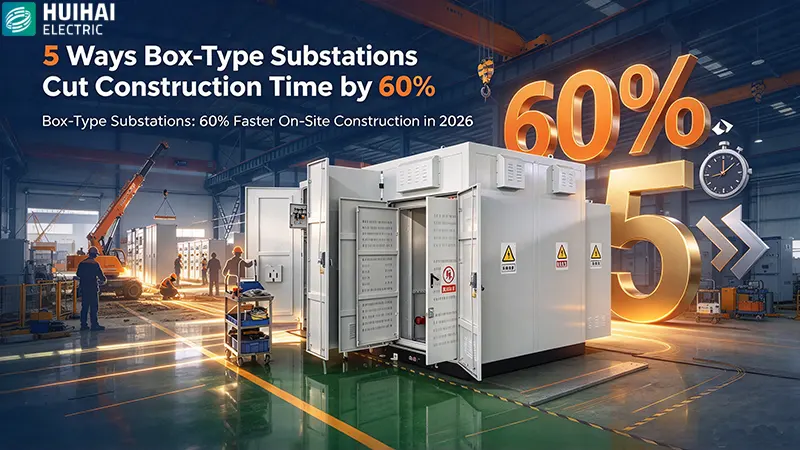
1. Factory Pre-Assembly Eliminates the Majority of On-Site Work
Method: Move assembly, wiring, and testing from the construction site to a controlled factory environment.
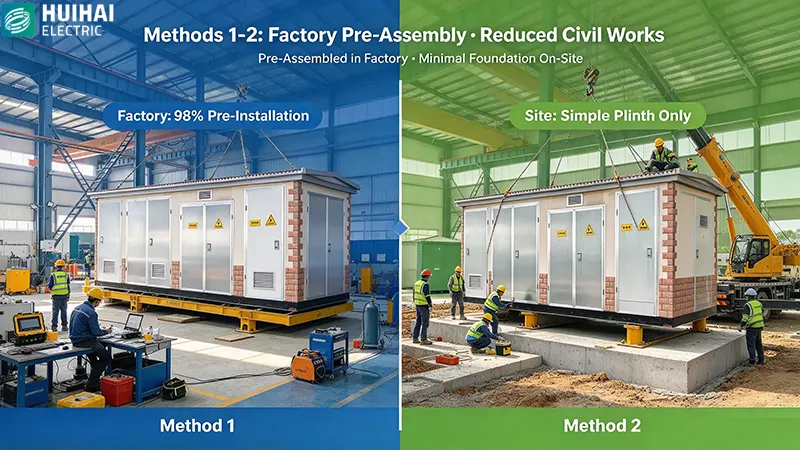
The single biggest reason box-type substations achieve 60% time savings is that the majority of work is completed before the equipment ever reaches the project site. In a traditional substation build, every component—transformer, switchgear, busbars, protection relays, control wiring—must be individually delivered, assembled, wired, and tested on-site. This sequential process is inherently slow and vulnerable to weather delays, labor shortages, and coordination failures.
Box-type substations invert this model. The entire assembly is completed in a factory environment, where skilled technicians work under controlled conditions with specialized tooling and quality assurance systems. Wiring, busbar connections, protection relay configuration, and factory acceptance testing are all performed before shipment.
When box-type substations arrive on-site, they are already fully assembled and tested. The on-site work reduces to foundation preparation, positioning, cable connection, and commissioning—tasks that take days rather than months.
What This Means for Project Timelines
- Traditional substation: 12 to 18 months from groundbreaking to energization
- Box-type substation: 3 to 6 months total, with on-site work measured in days
- On-site construction time reduction: up to 60%
2. Reduced Civil Works Cut Weeks from the Construction Schedule
Method: Minimize foundation, building, and infrastructure requirements through compact, integrated design.
Civil works are often the most time-consuming and unpredictable phase of substation construction. Traditional substations require extensive foundation digging, reinforced concrete plinths, control buildings, cable trenches, oil containment systems, and ventilation infrastructure. Each of these activities requires separate subcontractors, inspections, and curing periods that extend the project timeline.
Box-type substations drastically reduce civil works requirements. Because the equipment is housed in a self-contained enclosure, the foundation requirements are minimal—typically a simple concrete plinth or pad with cable entry provisions. There is no need for a separate control building, no oil containment vaults, and no complex ventilation systems.
For box-type substations installed at grade level, the foundation work can often be completed in parallel with factory production, so that the site is ready the moment the equipment arrives. This parallel workflow is a critical enabler of the 60% time reduction.
Civil Works Comparison
| Civil Work Activity | Traditional Substation | Box-Type Substation |
|---|---|---|
| Foundation | Extensive reinforced concrete | Simple concrete plinth |
| Control Building | Required | Not required |
| Oil Containment | Required for oil-filled units | Not required |
| Ventilation Systems | Complex ductwork and fans | Integrated in enclosure |
| Cable Trenches | Extensive network | Minimal, direct entry |
| Estimated Duration | 4-8 months | 2-6 weeks |
3. Parallel Workflows Allow Factory and Site Activities to Proceed Simultaneously
Method: Decouple factory production from site preparation so both proceed at the same time.
In traditional substation construction, most activities are sequential. The foundation must be completed before the building is erected. The building must be completed before equipment installation begins. Equipment installation must be completed before wiring and testing can start. This linear dependency chain means that any delay at one stage cascades through the entire project.
Box-type substations break this dependency chain. Factory production of the substation enclosure, transformer, switchgear, and control systems proceeds independently of site preparation. While the factory is assembling and testing the box-type substation, the site team can be preparing the foundation, installing cable ducts, and completing all necessary civil works.
When the box-type substation arrives on-site, the foundation is already prepared and the site is ready for immediate installation. This parallel workflow eliminates the sequential delays that plague traditional construction and is a fundamental reason why box-type substations achieve 60% time savings.
Sequential vs. Parallel Construction
| Phase | Traditional (Sequential) | Box-Type (Parallel) |
|---|---|---|
| Months 1-3 | Foundation and civil works | Foundation (site) + Factory assembly (off-site) |
| Months 4-6 | Building erection | Factory testing + Site readiness |
| Months 7-12 | Equipment installation | Delivery and installation |
| Months 13-18 | Wiring, testing, commissioning | Connection and commissioning |
4. Plug-and-Play Connections Enable Rapid On-Site Installation
Method: Pre-engineered interfaces and standardized connections minimize on-site wiring and assembly.
One of the most time-consuming aspects of traditional substation construction is the on-site wiring and connection work. Hundreds or thousands of individual wires must be pulled, terminated, labeled, and tested. Busbar connections must be torqued to specification. Protection relay settings must be configured and verified.
Box-type substations eliminate most of this work through pre-engineered, plug-and-play interfaces. All internal wiring is completed at the factory, with cables pre-terminated and labeled. Busbar connections are pre-assembled and torqued to specification. Protection relays are pre-configured and factory-tested.
On-site, the work reduces to connecting the incoming and outgoing power cables, making the control interface connections, and performing final commissioning checks. This approach reduces on-site wiring time by 70% or more compared to traditional substations.
On-Site Installation Sequence for Box-Type Substations
- Foundation inspection and preparation (1 day)
- Delivery and positioning of box-type substation (1 day)
- Connection of incoming and outgoing power cables (1-2 days)
- Control and communication interface connections (1 day)
- Final commissioning and energization (1-2 days)
Total on-site time: 5 to 8 days.
5. Standardized Modular Designs Enable Repeatable, Predictable Delivery
Method: Use standardized modular designs that can be replicated across projects without redesign.
Every traditional substation is essentially a custom engineering project. Each one requires bespoke design, custom fabrication, and project-specific construction sequencing. This customization adds months to the front-end engineering phase and introduces variability that makes schedule prediction difficult.
Box-type substations are built on standardized modular platforms. While they can be customized for specific voltage, capacity, and environmental requirements, the core design—the enclosure structure, the internal layout, the connection interfaces, the protection scheme—is standardized and repeatable.
This standardization delivers several schedule benefits. Engineering time is reduced because the base design already exists. Procurement is simplified because standard components are used. Manufacturing is faster because production processes are optimized for repeat builds. And commissioning is quicker because the protection and control systems have been validated in previous installations.
For utilities and developers deploying multiple box-type substations across a portfolio of projects, this standardization creates a compounding schedule advantage. Each successive project benefits from the lessons learned on previous ones, and the learning curve flattens rapidly.
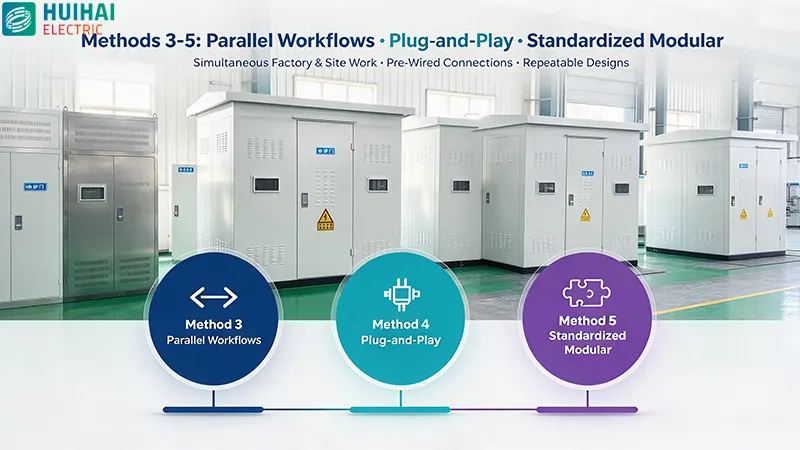
Summary: The 5 Ways at a Glance
| # | Method | Time Saving Mechanism | Typical Impact |
|---|---|---|---|
| 1 | Factory Pre-Assembly | Moves assembly and testing off-site | Up to 60% reduction |
| 2 | Reduced Civil Works | Eliminates buildings, vaults, and complex foundations | 4-8 months to 2-6 weeks |
| 3 | Parallel Workflows | Factory and site work proceed simultaneously | Eliminates sequential delays |
| 4 | Plug-and-Play Connections | Pre-wired, pre-tested interfaces | 5-8 days on-site installation |
| 5 | Standardized Modular Designs | Repeatable designs reduce engineering and fabrication time | 40-50% engineering time saving |
Why Box-Type Substations Are the Future of Fast Power Distribution
The 60% construction time reduction achieved by box-type substations is not a marginal improvement—it is a fundamental transformation in how power distribution infrastructure is delivered. In an era where grid connection speed directly affects project economics, renewable energy integration, and urban development timelines, this advantage is decisive.
Box-type substations are increasingly specified for:
- Utility distribution networks requiring rapid grid reinforcement
- Solar and wind farms needing fast collector substation deployment
- Industrial facilities where downtime and construction disruption must be minimized
- Data centers with aggressive commissioning schedules
- Urban smart grid projects constrained by space and community disruption
- Rural electrification programs where speed and cost efficiency are critical
As the global box-type substation market continues its trajectory toward USD 32 billion by 2032, the technology is becoming the default choice for projects where schedule certainty matters as much as technical performance.
How Huihai Electric Delivers Fast Box-Type Substation Solutions
At Huihai Electric, we understand that project schedules are not just timelines—they are commitments to our customers' success. Our box-type substation portfolio is engineered to deliver the fastest possible deployment without compromising quality, safety, or compliance.
Our Box-Type Substation Product Range
- Intelligent Box-Type Substations: Equipped with RTU monitoring terminals and CCU communication controllers, enabling remote control, remote signaling, telemetry, and automatic meter reading
- Compact-Type Substations: Featuring HXGN15-12 or HXGN7A-12 ring main units and corrugated oil tank transformers, suitable for schemes with fewer outgoing lines
- Buried-Type Substations: Switch chamber and transformer arranged in a superimposed way, with the transformer buried underground to reduce occupied area and running noise
- Prefabricated Substation Enclosures: Available in non-metallic landscape, metal, aluminum alloy, and stainless steel configurations
Why Huihai Electric for Box-Type Substations
- Integrated manufacturing: We produce transformers, switchgear, and enclosures under one roof, eliminating multi-vendor coordination delays
- Factory pre-testing: All box-type substations undergo comprehensive factory acceptance testing before shipment
- Rapid delivery: Standard configurations can be delivered in 4-6 weeks; customized solutions in 8-12 weeks
- Full standards compliance: IEC 62271-202, IEC 60076, and IEEE standards with complete type test reports
- Global support: Technical support and spare parts available for projects worldwide
Huihai Electric Co., Ltd. was incorporated in 2010 and is located at the foot of Mount Tai in Tai'an City, Shandong Province. The company operates from a modern manufacturing facility covering more than 70 mu with a workshop area of 26,000 square meters. With over 280 staff members, including 57 technical R&D personnel, Huihai Electric has achieved an annual output value exceeding 300 million yuan and serves customers across utility, industrial, and renewable energy sectors.
Our box-type substations are designed for the projects that cannot afford delays—the solar farms that need to hit their grid connection deadline, the data centers that must be energized on schedule, the industrial facilities where every day of construction disruption costs money. With Huihai Electric, you get a partner committed to delivering on time, every time.
Ready to accelerate your next power distribution project with box-type substations?
Contact Huihai Electric today to discuss your project specifications, request technical documentation, or schedule a virtual factory tour.
Huihai Electric Co., Ltd.
Editor Xu
www.huihai-electric.com
WhatsApp:+86 139 1136 0187
Email:info@huihai-electric.com
- Basic Winter Maintenance Measures for Oil-Immersed Transformers
- Top 9 Dry-Type Transformer Safety Standards for Global Power Project Compliance in 2026
- Top 7 Applications Driving Dry-Type Transformer Demand in 2026 — From Data Centers to Petrochemicals
- Avoid Costly Mistakes: 8 Dry-Type Transformer Specs to Verify Before Purchase
HUIHAIElectric
Huihai Electric is a leading manufacturer of smart grid equipment in China.