Huihai
Electric
Top 9 Dry-Type Transformer Safety Standards for Global Power Project Compliance in 2026
Global power projects—whether utility substations, industrial facilities, data centers, or renewable energy installations—demand dry-type transformers that meet stringent safety standards. Unlike oil-filled units, dry-type transformers eliminate fire hazards and environmental contamination risks, but their safety performance depends entirely on compliance with international standards that govern insulation, temperature rise, short-circuit withstand, and fire behavior.
With the global dry-type transformer market projected to grow from USD 18.37 billion in 2026 to over USD 24 billion by 2031, the regulatory landscape is becoming more complex and more consequential. A transformer that fails to meet applicable standards can delay project approvals, void insurance coverage, and—most critically—endanger personnel and assets.
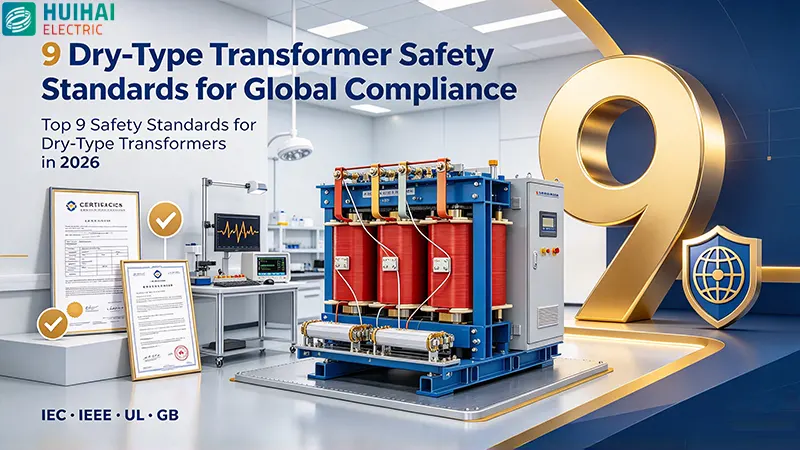
This guide covers the top 9 dry-type transformer safety standards that every global power project must verify for compliance in 2026. Each standard is essential for ensuring safety, reliability, and regulatory acceptance across different markets.
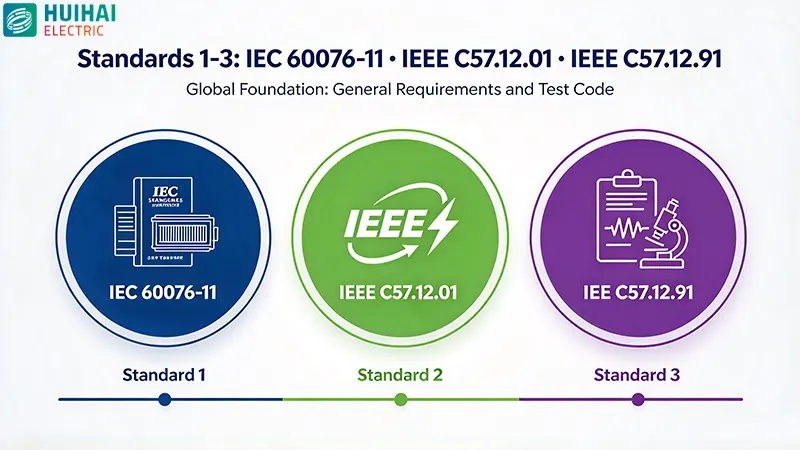
1. IEC 60076-11 — The Foundational International Standard for Dry-Type Transformers
Standard: IEC 60076-11:2018 (Power Transformers — Part 11: Dry-Type Transformers)
Scope: Dry-type power transformers (including auto-transformers) with highest voltage for equipment up to and including 72.5 kV and at least one winding operating at greater than 1.1 kV
Applicable Markets: Global (IEC member countries, Europe, Asia, Africa, Middle East, Latin America)
IEC 60076-11 is the primary and most comprehensive international standard for dry-type transformers. First published in 2004 and significantly revised in 2018, this standard establishes the framework for safety, performance, and testing that most global projects reference—directly or indirectly.
Key Safety Requirements
- Temperature rise limits — Defines maximum permissible temperature rises for windings and cores under rated load conditions
- Dielectric tests — Specifies power frequency withstand voltage and lightning impulse withstand voltage requirements
- Short-circuit withstand — Establishes thermal and dynamic withstand capability requirements
- Environmental, climatic, and fire behavior classes — Introduces standardized classification systems (E1/E2, C1/C2, F1) that must be selected based on installation conditions, not assumed
- Seismic classification — New in the 2018 edition, addressing installations in seismic zones
Classification System: Environment, Climate, and Fire Safety
| Category | Class | Description |
|---|---|---|
| Environment | E0 | No condensation; pollution can be neglected |
| E1 | Occasional condensation; limited pollution possible | |
| E2 | Frequent condensation or pollution, or both | |
| Climate | C1 | Indoor installation, not below -5°C |
| C2 | Outdoor installation down to -25°C | |
| Fire Safety | F0 | No special fire risk measures required |
| F1 | Fire risk limited by transformer properties; restricted flammability required |
For most urban and industrial projects, E2, C2, and F1 classifications are specified. Cast-resin dry-type transformers should at least meet C2 (Climate), E1 or E2 (Environment), and F1 (Fire Safety) requirements per IEC 60076-11.
Type Tests Required
- Temperature-rise test
- Lightning impulse withstand test
- Power frequency withstand test
- Short-circuit withstand test
- Partial discharge measurement
2. IEEE C57.12.01 — North American General Requirements for Dry-Type Transformers
Standard: IEEE C57.12.01 (General Requirements for Dry-Type Distribution and Power Transformers)
Scope: Ventilated, non-ventilated, and sealed dry-type distribution and power transformers or autotransformers (single and polyphase, with a voltage of 601 V or higher in the highest voltage winding)
Applicable Markets: United States, Canada, and other markets following ANSI/IEEE standards
IEEE C57.12.01 is the governing standard for dry-type transformers in North America. It specifies electrical, mechanical, and safety requirements that complement—but differ from—IEC standards.
Key Safety Requirements
- Dielectric insulation levels — Defines BIL (Basic Lightning Impulse Insulation Level) and power frequency withstand requirements for systems with BIL ratings 200 kV and below
- Temperature rise limits — Specifies maximum average winding and hot-spot temperature rises
- Construction requirements — Covers enclosure integrity, grounding, and safety clearances
- Nameplate data — Mandates specific information that must appear on the transformer nameplate
Key Differences from IEC Standards
- Voltage threshold: IEEE C57.12.01 applies to transformers with 601 V or higher in the highest voltage winding; IEC 60076-11 applies to those with at least one winding above 1.1 kV
- Testing procedures: IEEE references C57.12.91 as the test code; IEC 60076-11 includes tests within the standard
- Classification system: IEEE does not use the E/C/F classification system found in IEC 60076-11
3. IEEE C57.12.91 — Test Code for Dry-Type Distribution and Power Transformers
Standard: IEEE C57.12.91 (Standard Test Code for Dry-Type Distribution and Power Transformers)
Scope: All dry-type transformers except instrument transformers, step-voltage and induction voltage regulators, arc furnace transformers, rectifier transformers, and specialty transformers
Applicable Markets: North America and global projects referencing IEEE standards
IEEE C57.12.91 provides the test methods and procedures for verifying compliance with C57.12.01 and other referenced standards. This is the standard that laboratories and manufacturers follow when conducting routine and type tests on dry-type transformers.
Required Tests
| Test Category | Tests Included |
|---|---|
| Routine Tests (every unit) | Winding resistance measurement; Turns ratio test; Polarity and phase relation test; No-load loss and excitation current; Load loss and impedance; Insulation resistance; Dielectric tests |
| Type Tests (design validation) | Temperature-rise test; Lightning impulse test; Short-circuit withstand test; Partial discharge test |
| Special Tests (as specified) | Sound level measurement; Harmonic loss measurement; K-factor verification |
For North American projects, IEEE C57.12.91 is the mandatory test code that procurement specifications should reference. Third-party test reports from accredited laboratories (UL, KEMA, CESI, or equivalent) provide the strongest evidence of compliance.
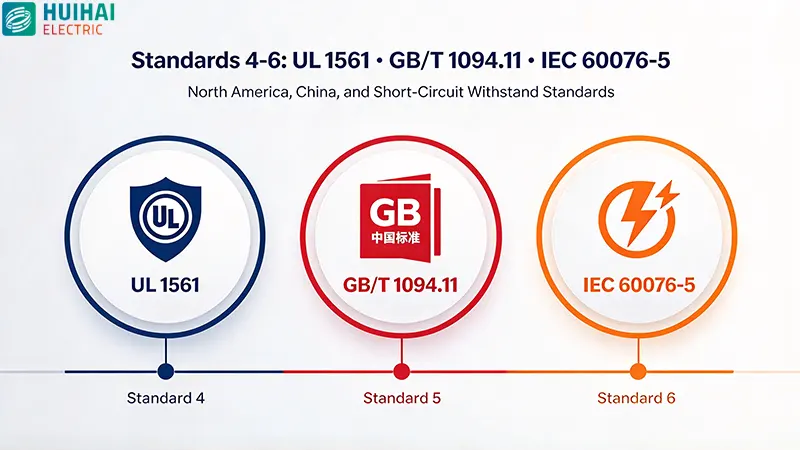
4. UL 1561 — Safety Certification for Dry-Type General Purpose and Power Transformers
Standard: UL 1561 (Standard for Safety for Dry Type General Purpose and Power Transformers, 600 Volts or Less)
Scope: Dry-type general purpose and power transformers rated 600 V or less
Applicable Markets: United States and Canada (in conjunction with CSA standards)
UL 1561 is the principal safety standard for dry-type transformers rated 600 V or less in North America. While IEEE C57.12.01 establishes performance requirements, UL 1561 focuses specifically on safety—fire, electric shock, and mechanical hazards.
Key Safety Requirements
- Overload test — Verifies transformer safety under overload conditions
- Temperature rise limits — Specifies maximum temperature rises for different insulation classes
- K-factor rated transformers — Must be subjected to matching non-sinusoidal harmonic loads, with permitted test methods including loading-back and resistance methods
- Bonding and grounding — Covers bonding jumper requirements for core-to-enclosure grounding
- Construction requirements — Enclosure integrity, clearances, and material requirements
For K-factor rated transformers, UL 1561 requires a minimum neutral bar rating of approximately 200% of the transformer's full load amps to handle additive harmonic currents. The temperature test follows ANSI/IEEE C57.12.91 procedures.
UL Listing vs. UL Recognition: For commercial and industrial installations in North America, a UL Listed transformer provides the strongest assurance of code compliance and is often required by local electrical inspectors.
5. GB/T 1094.11-2022 — China's National Standard for Dry-Type Transformers
Standard: GB/T 1094.11-2022 (Power Transformers — Part 11: Dry-Type Transformers)
Scope: Dry-type power transformers (including auto-transformers) with highest voltage for equipment up to and including 72.5 kV and at least one winding operating at greater than 1.1 kV
Applicable Markets: China and export projects referencing Chinese standards
GB/T 1094.11-2022 is China's national standard for dry-type transformers, harmonized with IEC 60076-11 but adapted to Chinese market requirements. It specifies terms, operating conditions, ratings, tapping, short-circuit withstand, nameplate data, temperature rise limits, insulation levels, environmental and fire behavior classes, seismic characteristics, testing, protection against direct contact, enclosure protection (IP codes), earthing terminals, and safety requirements.
Key Safety Requirements
- Temperature rise limits — Consistent with IEC requirements but with specific values for Chinese market conditions
- Insulation levels — Power frequency and lightning impulse withstand voltages matching Chinese system voltages
- Environmental and fire behavior classes — Aligned with IEC E/C/F classification system
- Seismic characteristics — Requirements for installations in China's seismic zones
- Enclosure protection (IP codes) — Specifies minimum IP ratings for different installation environments
- Protection against direct contact — Safety requirements for accessible live parts
For projects in China or those sourcing Chinese-manufactured dry-type transformers, GB/T 1094.11-2022 compliance is essential. The standard is complemented by GB/T 10228 for specific dry-type transformer requirements.
6. IEC 60076-5 — Short-Circuit Withstand Capability
Standard: IEC 60076-5 (Power Transformers — Part 5: Ability to Withstand Short Circuit)
Scope: Power transformers, including dry-type, with rated power above 25 kVA
Applicable Markets: Global (referenced by IEC 60076-11 and most procurement specifications)
Short-circuit withstand capability is one of the most critical safety parameters for dry-type transformers. During a fault, the transformer must withstand enormous electromagnetic forces and thermal stress without mechanical failure or insulation breakdown.
Key Requirements
- Thermal withstand — The transformer must withstand the thermal effects of short-circuit current for a specified duration (typically 2 seconds)
- Dynamic withstand — The transformer must withstand the peak electromagnetic forces generated during the first cycle of a short circuit
- Post-test verification — After short-circuit testing, the transformer must pass dielectric tests to confirm insulation integrity
For dry-type transformers, the ability to withstand short circuits is particularly important because the solid insulation system cannot self-heal like oil. Cast-resin transformers with glass-fiber reinforcement demonstrate superior short-circuit withstand capability compared to VPI designs.
Procurement note: Always request short-circuit test reports from accredited laboratories for the specific transformer design and rating being purchased. A "type tested" claim without documentation is insufficient.
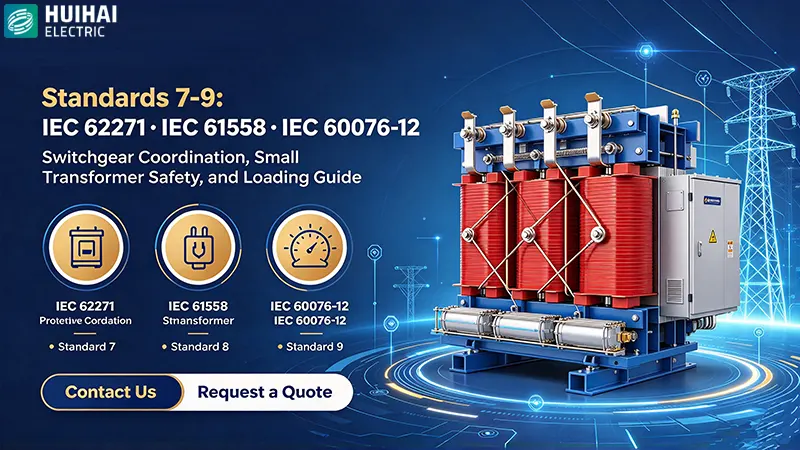
7. IEC 62271 Series — High-Voltage Switchgear Coordination
Standard: IEC 62271 series (High-Voltage Switchgear and Controlgear)
Scope: AC switchgear and controlgear for rated voltages above 1 kV
Applicable Markets: Global
While dry-type transformers are not switchgear, they must coordinate with switchgear protection systems for safe operation. The IEC 62271 series establishes requirements for the switchgear that protects, isolates, and controls the transformer—and the transformer's characteristics directly affect switchgear selection.
Key Coordination Considerations
- Short-circuit current contribution — The transformer's impedance (%Z) determines the fault current that switchgear must interrupt
- Protection coordination — Transformer protection relays must coordinate with upstream and downstream switchgear
- Insulation coordination — The transformer's BIL level must be compatible with the switchgear's insulation level
- Enclosure integration — When transformer and switchgear are housed in the same enclosure (as in prefabricated substations), IEC 62271-202 applies
IEC 62271-202 specifically addresses AC prefabricated substations for rated voltages above 1 kV and up to 52 kV, covering the complete assembly of transformer, switchgear, and control equipment in a single enclosure.
8. IEC 61558 Series — Safety of Small Power Transformers
Standard: IEC 61558 series (Safety of Transformers, Reactors, Power Supply Units and Combinations Thereof)
Scope: Transformers with rated supply voltage not exceeding 1,000 V AC and rated frequency not exceeding 500 Hz
Applicable Markets: Global
For smaller dry-type transformers used in auxiliary, control, and low-voltage applications, IEC 61558 establishes safety requirements that complement the larger power transformer standards.
Key Safety Aspects
- Electrical safety — Insulation, clearances, and dielectric strength
- Thermal safety — Temperature rise limits and thermal protection
- Mechanical safety — Enclosure integrity, protection against moving parts
- Specific applications — IEC 61558-2-23 covers isolating and safety isolating dry-type transformers for construction sites
For power projects, IEC 61558-1 (general requirements) and specific part 2 standards apply to auxiliary transformers, control transformers, and low-voltage distribution transformers that are part of the overall power system.
9. IEC 60076-12 — Loading Guide for Dry-Type Transformers
Standard: IEC 60076-12 (Power Transformers — Part 12: Loading Guide for Dry-Type Power Transformers)
Scope: Loading guidance for dry-type power transformers
Applicable Markets: Global
IEC 60076-12 provides the loading guidance necessary to ensure safe operation of dry-type transformers under both normal and emergency conditions. While often overlooked in procurement, this standard directly affects safety by defining the limits within which transformers can operate without compromising insulation life or safety.
Key Safety Aspects
- Normal cyclic loading — Defines permissible load cycles under normal operating conditions
- Emergency loading — Specifies time limits and temperature limits for emergency overload conditions
- Ambient temperature correction — Provides factors for adjusting loading limits based on installation ambient temperature
- Altitude correction — Addresses reduced cooling effectiveness at high altitudes
Understanding loading limits is essential for safety because excessive loading accelerates insulation aging and can lead to premature failure. Every 10°C rise above rated temperature can halve insulation life. IEC 60076-12 provides the engineering basis for setting protection relay thresholds and designing adequate cooling systems.
Summary: The 9 Safety Standards at a Glance
| # | Standard | Scope | Primary Market | Key Safety Focus |
|---|---|---|---|---|
| 1 | IEC 60076-11 | Dry-type transformers up to 72.5 kV | Global | Comprehensive safety, classification, testing |
| 2 | IEEE C57.12.01 | Dry-type transformers ≥601 V | North America | General requirements, dielectric levels |
| 3 | IEEE C57.12.91 | Test code for dry-type transformers | North America | Test methods and procedures |
| 4 | UL 1561 | Dry-type transformers ≤600 V | US/Canada | Safety certification, K-factor, overload |
| 5 | GB/T 1094.11-2022 | Dry-type transformers up to 72.5 kV | China | National standard, seismic, IP codes |
| 6 | IEC 60076-5 | Short-circuit withstand | Global | Thermal and dynamic withstand |
| 7 | IEC 62271 | High-voltage switchgear | Global | Switchgear-transformer coordination |
| 8 | IEC 61558 | Small power transformers | Global | Auxiliary and control transformer safety |
| 9 | IEC 60076-12 | Loading guide for dry-type transformers | Global | Safe loading limits and thermal management |
Compliance Checklist for Global Power Projects
Before finalizing a dry-type transformer procurement, verify the following:
1. Standards Identification
- Identify which standards apply to your project jurisdiction (IEC, IEEE, UL, GB, or a combination)
- Confirm the specific edition and amendment level required by your project specifications
- Verify whether local electrical codes impose additional requirements beyond international standards
2. Certification Verification
- Request type test reports from accredited independent laboratories (KEMA, CESI, UL, or equivalent)
- Verify that test reports cover the specific design and rating being purchased—not a similar model
- Check that certifications are current and not expired
- Confirm third-party certification marks (CE, UL, CQC) where applicable
3. Classification Selection
- Determine required environmental class (E0, E1, or E2) based on installation conditions
- Determine required climate class (C1 or C2) based on installation location
- Determine required fire safety class (F0 or F1) based on fire risk assessment
- Verify seismic class requirements for installations in seismic zones
4. Documentation Review
- Review test reports for temperature rise, insulation, short-circuit, and partial discharge
- Confirm nameplate data meets applicable standard requirements
- Verify installation and maintenance manuals are provided and compliant
- Check that enclosure IP ratings match installation environment requirements
Why Huihai Electric for Compliant Dry-Type Transformer Solutions
At Huihai Electric, we understand that global power projects demand dry-type transformers that meet the most stringent safety standards. Our dry-type transformer portfolio is designed and manufactured to comply with IEC 60076-11, IEEE C57.12.01, GB/T 1094.11-2022, and applicable UL requirements.
What Huihai Electric Delivers
- Full standards compliance — IEC, IEEE, GB, and UL as applicable to project requirements
- Complete type test reports — From accredited independent laboratories
- Cast-resin and VPI transformers — With F1 fire classification and E2/C2 environmental ratings
- Third-party certifications — Including ISO 9001, ISO 14001, and CE where applicable
- Documentation packages — Including test reports, drawings, and manuals for project submittals
- Global technical support — From design through commissioning and operation
Whether your project is in Europe, North America, Asia, or emerging markets, Huihai Electric delivers dry-type transformers that meet your regulatory requirements and perform reliably for decades.
Need help verifying dry-type transformer compliance for your global project?
Contact Huihai Electric today to discuss your standards requirements, request technical documentation, or schedule a factory audit.
Huihai Electric Co., Ltd.
Editor Xu
www.huihai-electric.com
WhatsApp:+86 139 1136 0187
Email:info@huihai-electric.com
- Best 5 High Voltage Switchgear Models for Outdoor Power Distribution Systems
- Top 9 Best Practices for Prefabricated Substation Design in Solar and Wind Projects
- Dry-Type Transformers: The Backbone of Modern Smart Grid Infrastructure
- The 8 Key Roles of Temperature and Humidity Controllers in High and Low Voltage Switchgear
HUIHAIElectric
Huihai Electric is a leading manufacturer of smart grid equipment in China.