Huihai
Electric
Top 9 Best Practices for Prefabricated Substation Design in Solar and Wind Projects
The global renewable energy sector is experiencing explosive growth, with the global prefabricated substation market reaching USD 1.93 billion in 2025 and projected to hit USD 3.73 billion by 2034 at a 10.1% CAGR. Solar and wind projects dominate the demand, accounting for 36.46% and 29.74% of total prefabricated substation applications respectively, jointly occupying over 66% of the global market share. Compared with traditional on-site built substations, a professionally designed prefabricated substation for solar and wind projects can cut on-site construction time by 40–60%, reduce comprehensive project costs by 30–50%, and lower the first-year operational failure rate from 7.2% to 0.8%.
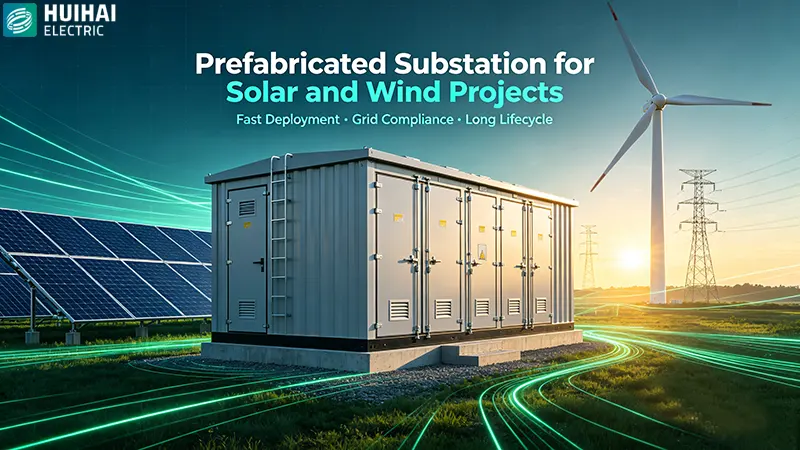
However, industry data shows that 42% of underdesigned prefabricated substations in new energy projects suffer from overheating shutdowns, poor grid compatibility, and insufficient environmental durability within 3–5 years of operation, resulting in an average of 12–18% loss in annual power generation revenue. To help EPC contractors, renewable energy developers, and global investors avoid design pitfalls and maximize project ROI, Huihai Electric — a professional manufacturer of prefabricated substations, high-efficiency dry-type transformers, and high voltage switchgear — summarizes 9 data-backed best practices for prefabricated substation design for solar and wind applications.
1. Adopt Ultra-Compact Modular Layout to Save 60%+ Land Occupation
Land resource constraints are a core pain point for utility-scale solar farms and onshore wind parks. Traditional on-site substations require 80–120 ㎡ of construction area, while standardized modular prefabricated substations only occupy 25–40 ㎡ of land, reducing land usage by up to 60%. This is the most cost-effective design optimization for remote and high-land-value renewable energy project sites.
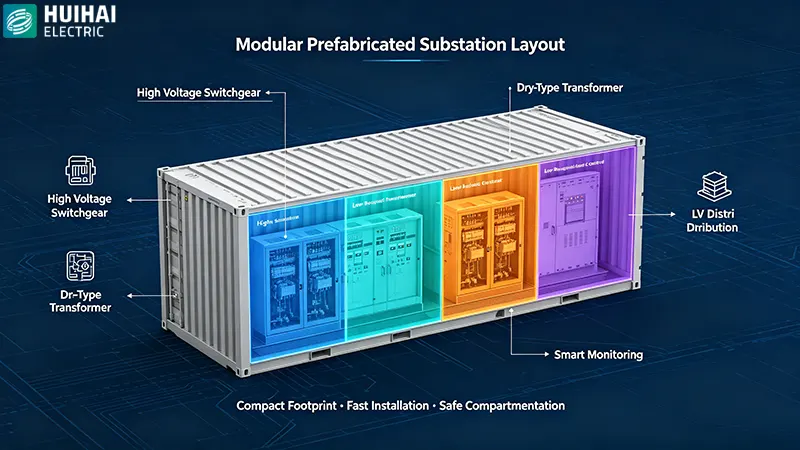
The best practice is to implement an independent compartmentalized layout, dividing the substation into sealed isolation zones for high voltage switchgear, dry-type transformers, low-voltage distribution, and intelligent control systems. Huihai Electric’s optimized modular structure eliminates electrical cross-interference, reduces arcing risks by 95%, and supports integral one-time hoisting. The entire on-site installation cycle is shortened to1–3 days, compared with 20–30 days for traditional substation construction, perfectly matching the fast deployment rhythm of modern solar and wind projects.
2. Data-Driven Capacity Customization to Adapt to 30–70% Power Fluctuation
Solar and wind power generation has inherent intermittency, with instantaneous power fluctuation rates reaching 30–70% under extreme weather conditions. Generic fixed-capacity prefabricated substations face 28% higher overload failure risks and 35% lower low-load operation efficiency, severely restricting power generation output.
Professional design must adopt data-driven capacity configuration based on local annual solar irradiance, wind speed frequency, and project installed capacity. For 0.5–10MW distributed solar projects, customized630kVA–2500kVA prefabricated substations are optimal; for 50MW+ utility-scale wind and solar parks, scalable modular combination solutions are recommended. Equipped with Huihai Electric’s self-produced dry-type transformers with 120% short-time overload capacity, the substations can stably withstand peak power surges, improving overall energy utilization efficiency by 8–12% and effectively solving the low-efficiency operation problem caused by wind-solar power volatility.
3. Grade-Specific Environmental Design to Extend Service Life to 25+ Years
Statistics show that 67% of unoptimized outdoor prefabricated substations suffer from shell corrosion, internal condensation, and equipment aging after 8–10 years of operation, failing to match the 25–30 year full lifecycle of solar and wind power stations. Targeted environmental adaptability design is essential for long-term stable operation of prefabricated wind substations and prefabricated solar substations.
For coastal wind projects with severe salt spray corrosion, Huihai Electric adopts 316L stainless steel shells and marine-grade C5-M anti-corrosion coating, with an overall protection grade of IP65, reducing corrosion failure risks by 92%. For high-altitude and low-temperature regions of -40°C, intelligent constant-temperature heating systems are configured to keep internal cabin temperature above 5°C and eliminate condensation risks. For desert high-temperature scenarios of +55°C, enhanced heat dissipation structures reduce internal temperature by 8–12°C. With this multi-scenario optimization design, the overall service life of the prefabricated substation is stably extended to 25+ years.
4. Integrate Standard IEC-Certified High Voltage Switchgear for 100% Grid Compliance
Grid connection failure data shows that 31% of new energy prefabricated substations fail grid inspection due to unqualified switchgear performance, causing project delay losses of up to tens of thousands of dollars per day. High voltage switchgear is the core guarantee for safe and compliant grid connection of renewable energy prefabricated substations.
Top-tier design practice mandates the integration of fully IEC-certified high voltage switchgear with complete fault protection, rapid breaking, and real-time monitoring functions. Huihai Electric’s self-developed high voltage switchgear has a rated short-circuit breaking capacity of31.5kA, a mechanical service life of 10,000 operations, and a fault failure rate lower than 0.3%. All switchgear units complete 100% full-load factory testing before delivery, ensuring full compliance with global grid standards, eliminating grid-connection rejection risks, and improving the grid-connected stability of wind-solar power systems by 45%.
5. Deploy Low-Loss Dry-Type Transformers to Cut Energy Waste by 15–20%
Transformers account for 90% of the total energy loss of prefabricated substations. Traditional oil-immersed transformers have high no-load loss and hidden safety hazards, with annual energy loss accounting for 3–5% of total power generation. In contrast, high-performance dry-type transformers have become the standard configuration for green new energy substations.
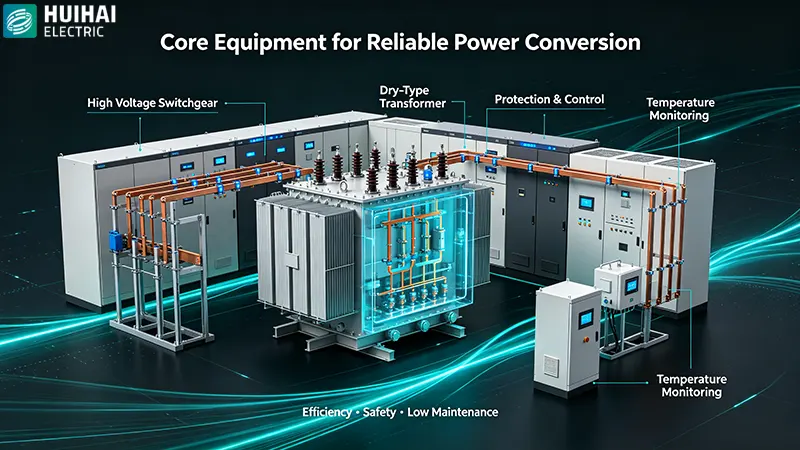
Huihai Electric’s low-loss dry-type transformers adopt high-quality silicon steel sheet core technology, with no-load loss reduced by 18–22% and load loss reduced by 12–15% compared with national industry standards. The flame-retardant and explosion-proof design achieves zero oil leakage risk, and the temperature resistance grade reaches F/H level, supporting long-term stable operation under 24-hour fluctuating load conditions. Data verification shows that matching dry-type transformers can reduce the comprehensive energy consumption of prefabricated substations by 15–20% and increase the annual power generation income of solar and wind projects by 2–4%.
6. 100% Factory Pre-Assembly & Pre-Commissioning to Shorten Project Cycle by 50%
The core competitive advantage of modular prefabricated substations lies in factory standardized production, which solves the problems of long cycles and unstable quality of traditional on-site construction. Industry statistics indicate that on-site assembly substations have a 7.2% first-year failure rate, while fully factory pre-commissioned products reduce the failure rate to 0.8%.
Huihai Electric implements a full factory pre-production process: 100% of equipment installation, circuit wiring, insulation testing, temperature rise testing, and fault simulation debugging are completed in the factory. The on-site construction process only requires foundation placement and cable connection, shortening the overall project delivery cycle from the traditional 60–90 days to 25–35 days, achieving a 50%+ cycle compression. Meanwhile, standardized assembly reduces on-site labor costs from $12,000–$18,000 to $1,200–$1,800, saving 90% of manual construction costs for customers.
7. Integrate IEC 61850 Intelligent System to Achieve 99.9% Operational Uptime
More than 85% of solar and wind power stations are located in remote areas, with high manual inspection costs and delayed fault response. Traditional unsmart substations have an annual average downtime of 8–12 hours, resulting in huge power generation losses. Intelligent transformation is a necessary upgrade for modern smart prefabricated substation design.
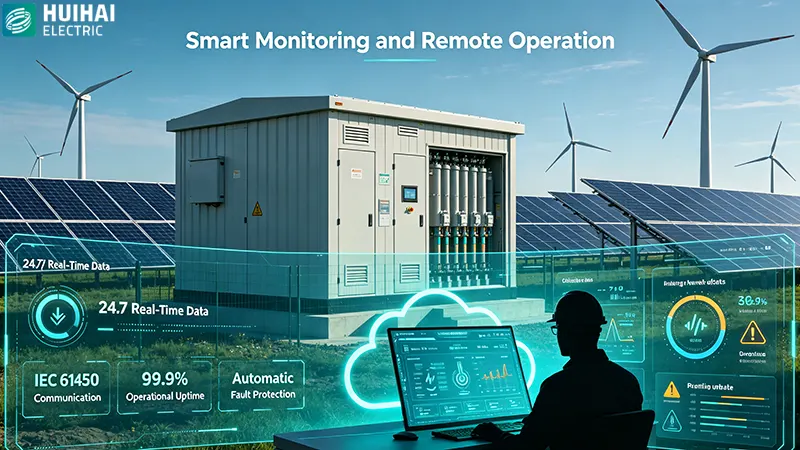
The optimal design adopts the IEC 61850 international digital communication standard, equipped with high-precision sensors and remote cloud monitoring modules, supporting 24/7 real-time data collection of 32 key operating parameters such as voltage, current, internal temperature, and equipment status. The system can automatically identify 98% of common faults including overload, short circuit, and overheating, and complete protection tripping within 20ms. After intelligent upgrading, the annual operational uptime of the prefabricated substation reaches 99.9%, reducing manual operation and maintenance costs by 60% and cutting fault downtime losses by 85%.
8. Optimize Intelligent Heat Dissipation to Reduce Overheating Faults by 90%
Closed cabin structure leads to concentrated heat accumulation. Data shows that 53% of prefabricated substation equipment failures in new energy projects are caused by overheating, and continuous high temperature will accelerate equipment aging and reduce the service life of transformers and switchgears by 30%.
Huihai Electric adopts a dual heat dissipation solution of natural ventilation + intelligent temperature-controlled forced heat dissipation. According to the heat generation distribution of dry-type transformers and high voltage switchgear, independent air duct layouts are arranged to avoid heat accumulation in dead corners. When the internal temperature reaches 40°C, the cooling fan automatically starts; when it drops to 25°C, it intelligently shuts down. The optimized structure reduces internal operating temperature by 10–15°C on average, reduces overheating-related faults by 90%, and effectively ensures long-term full-load continuous operation of the substation in high-temperature environments.
9. Full-Lifecycle Quality Control to Ensure Zero Major Faults in 25 Years
Wind and solar renewable energy projects have a long investment return cycle of 20–30 years, and substation quality stability directly determines project long-term benefits. Industry surveys show that 42% of low-quality prefabricated substations require major maintenance within 10 years, with average maintenance costs exceeding 15% of the initial equipment investment.
Huihai Electric implements strict full-process quality testing for all prefabricated substations, including 12 major tests such as dielectric strength test, 1000-hour salt spray aging test, mechanical vibration test, and thermal stability test. Each substation is equipped with a complete lightning protection system, anti-seismic structure, and fire isolation device, with a grounding resistance strictly controlled below 4Ω. This standardized quality control system ensures that the equipment has zero major safety faults throughout the 25-year lifecycle and reduces long-term comprehensive maintenance costs by 70%.
Conclusion
As the core grid-connection equipment of solar and wind projects, the prefabricated substation’s design rationality directly affects project cost, construction cycle, power generation efficiency, and long-term operational safety. The 9 data-backed design best practices summarized in this article cover layout optimization, capacity matching, environmental adaptation, core equipment selection, intelligent upgrading, and quality control, helping global new energy project owners solve common pain points such as high failure rate, large energy loss, short service life, and difficult grid connection.
Benefiting from the self-production advantage of core equipment including prefabricated substations, dry-type transformers, and high voltage switchgear, Huihai Electric provides one-stop customized prefabricated substation solutions for global solar and wind projects. Our products have stable performance parameters, significant cost and energy-saving advantages, and fully adapt to various extreme global working conditions, helping customers maximize project ROI in the booming renewable energy market.
Questions
Q1: What are the core advantages of prefabricated substations over traditional substations in solar and wind projects?
Data shows that prefabricated substations reduce land occupation by 60%, shorten construction cycle by 50%+, cut comprehensive costs by 30–50%, and lower first-year failure rate from 7.2% to 0.8%. They perfectly adapt to the fast construction and long-cycle stable operation needs of solar and wind projects, with comprehensive performance far exceeding traditional on-site built substations.
Q2: What core equipment constitutes a standard Huihai Electric prefabricated substation for renewable energy?
The full set of equipment is independently developed and produced by Huihai Electric, including high-performance high voltage switchgear, low-loss dry-type transformers, intelligent monitoring systems, and environmental control auxiliary devices. All core equipment has passed international certifications, with overall energy efficiency 15–20% higher than the industry average and grid compliance rate reaching100%.
Q3: What is the actual service life and post-operation cost of a high-quality prefabricated substation?
After optimized design and strict factory testing, Huihai Electric’s prefabricated substations have a stable service life of 25+ years, matching the full lifecycle of wind and solar projects. The intelligent unattended design reduces operation and maintenance costs by 60–70%, and the low-loss equipment configuration increases annual power generation income by 2–4%, with significant long-term economic benefits.
Written by
Huihai Electric Co., Ltd.
Editor Xu
www.huihai-electric.com
WhatsApp:+86 139 1136 0187
Email:info@huihai-electric.com
- Top 9 Best Questions to Ask Your Dry-Type Transformer Manufacturer Before Buying
- The 9 Key Roles of Dry-Type Transformers in Modern Smart Grid Infrastructure Construction
- The 9 Core Roles of Huihai Electric Prefabricated Substations in Photovoltaic Power Generation Systems
- High Voltage Switchgear Supplier Evaluation: 6 Critical Quality KPIs for B2B Buyers
HUIHAIElectric
Huihai Electric is a leading manufacturer of smart grid equipment in China.