Huihai
Electric
Cast Resin vs. VPI: Which Dry-Type Transformer Is Best for Harsh Environments?
Compare cast resin and VPI dry-type transformers for harsh environments. Learn which technology offers superior moisture resistance, mechanical strength, and long-term reliability for your industrial or utility project.
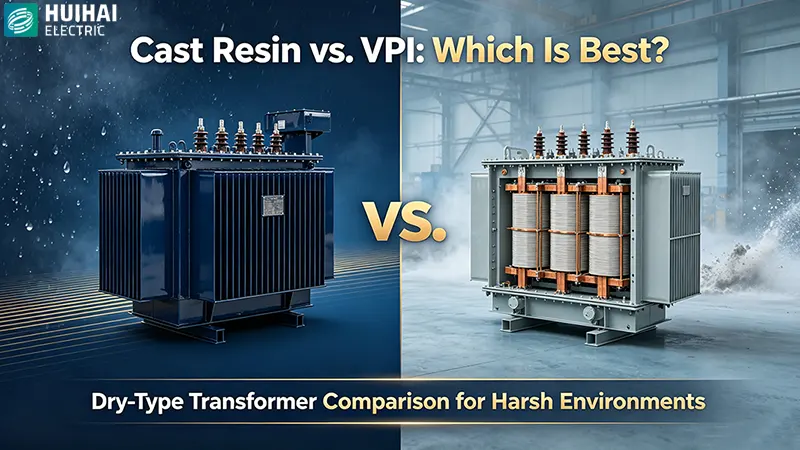
When specifying dry-type transformers for industrial, utility, or renewable energy projects, one of the most critical decisions engineers and procurement managers face is choosing between Cast Resin and Vacuum Pressure Impregnated (VPI) technology. Both are dry-type solutions that eliminate the fire and environmental risks of oil-filled transformers, but their performance in harsh environments could not be more different.
If your project involves high humidity, salt spray, chemical exposure, extreme temperatures, or outdoor conditions, the choice becomes even more consequential. Select the wrong technology, and you could face premature insulation failure, unplanned downtime, and costly replacements within years rather than decades.
This guide compares cast resin and VPI dry-type transformers across the dimensions that matter most for harsh-environment applications—helping you determine which is truly best for your project.
Understanding the Fundamental Difference
The distinction between cast resin and VPI transformers lies in how the windings are insulated.
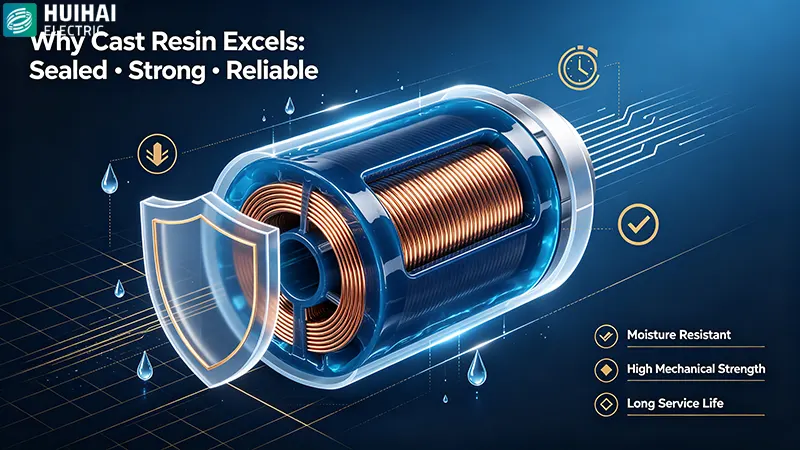
Cast Resin Transformers: Fully Encapsulated
Cast resin transformers use epoxy resin vacuum casting technology. The windings are placed into precision molds, and liquid epoxy resin is injected under vacuum conditions, then thermally cured. The result is a solid, void-free, completely encapsulated coil—a monolithic block of resin with the windings sealed permanently inside.
This is "sealed solid insulation". The conductor, insulation materials, and resin become a single integrated body with extremely high mechanical strength.
VPI Transformers: Impregnated but Open
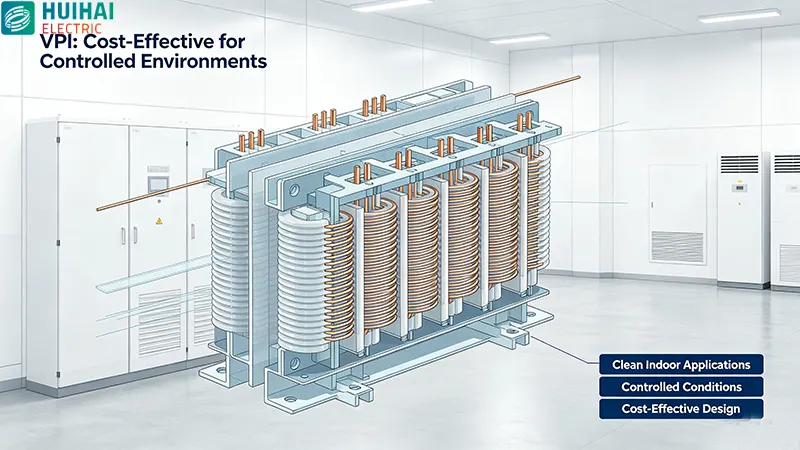
VPI transformers use a different approach. After winding, the coils are placed in a vacuum chamber where air and moisture are removed. Insulating varnish is then forced under pressure deep into the insulation layers, followed by baking and curing.
However, VPI transformers do not form a completely sealed solid shell. The winding structure retains air circulation paths and remains open to the environment. This is "enhanced impregnated insulation" rather than full encapsulation.
This fundamental difference—encapsulation vs. impregnation—drives every performance distinction that follows.
Head-to-Head Comparison: Key Performance Metrics
| Feature | Cast Resin Transformer | VPI Transformer |
| Moisture Resistance | Excellent. Fully sealed; impervious to moisture, dust, and chemical contaminants | Moderate. Varnish provides a barrier, but windings are not fully sealed and can absorb moisture in highly humid conditions |
| Mechanical Strength | Very high. Solid resin mass provides exceptional structural integrity and superior resistance to short-circuit forces | Moderate. Windings have some support from varnish but less than solid cast |
| Environmental Protection | Maximum. Ideal for harsh, high-moisture, unconditioned, or outdoor perimeter zones | Good in controlled environments; requires proper enclosure for outdoor use |
| Heat Dissipation | Good, but resin acts as an insulator; design must carefully prevent hot spots | Better. Open-wound design allows direct air circulation and rapid heat dissipation |
| Physical Attributes | Robust and heavy-duty | Compact and lightweight; ideal for multi-story or modular builds |
| Initial Cost | Higher (30–50% more than comparable VPI) | Lower. Simpler manufacturing process |
| Repairability | Not repairable. Failed winding requires full coil replacement | Can sometimes be repaired (rewound), though often not economical |
| Lifespan in Harsh Conditions | Longer. More reliable in wide range of conditions, including harsh and fluctuating environments | Shorter. VPI transformers generally have shorter lifespan compared to cast resin in harsh conditions |
Why Cast Resin Excels in Harsh Environments
For applications involving moisture, salt spray, dust, chemicals, or extreme temperatures, cast resin transformers are widely regarded as the superior choice. Here's why.
1. Unmatched Moisture and Contaminant Protection
The solid epoxy encapsulation of a cast resin transformer creates a completely sealed body. This provides exceptional resistance to moisture, salt spray, dust, and chemical agents.
Unlike VPI transformers, which remain open systems that cannot entirely block the ingress of moisture and contaminants, cast resin transformers can operate reliably even in 100% humidity conditions and can be re-energized after shutdown without requiring a drying-out period.
For harsh environments—including high-humidity, high-salinity, and heavily polluted areas—cast resin transformers generally provide stronger protection and reliability.
2. Superior Mechanical Strength and Short-Circuit Withstand
The solid epoxy casing provides extremely high mechanical strength. This robust structure effectively withstands:
- Vibrations during transport and operation
- The immense electromagnetic forces generated during sudden short circuits
- Seismic activity and physical impacts
This structural integrity makes cast resin a "set-it-and-forget-it" powerhouse for unconditioned spaces where mechanical robustness is non-negotiable.
3. Longer Service Life in Demanding Conditions
VPI transformers generally have a shorter lifespan compared to cast resin models in harsh conditions. Cast resin transformers are more reliable in environments prone to high moisture and pollutants.
The solid encapsulation protects against the gradual degradation that plagues open-wound designs in challenging environments—leading to a potentially longer service life overall.
4. Low Maintenance and High Reliability
Because the windings are completely sealed, cast resin transformers require minimal maintenance. There is no need for regular cleaning of coil surfaces, no concern about contamination buildup, and no risk of moisture ingress compromising insulation integrity.
This makes them ideal for remote or difficult-to-access installations where maintenance access is limited.
5. Fire Safety and Self-Extinguishing Properties
Cast resin transformers achieve F1 fire class with excellent self-extinguishing performance. The epoxy resin is flame-retardant and self-extinguishing—a critical advantage in safety-sensitive applications like hospitals, high-rise buildings, airports, and densely populated areas.
When VPI May Be the Better Choice
While cast resin is the clear winner for harsh environments, VPI transformers have their own strengths. They are an excellent, cost-effective choice for controlled indoor environments.
Choose VPI when:
- The installation is in a clean, climate-controlled indoor space (commercial buildings, standard industrial facilities, control centers)
- Initial cost is a primary constraint
- Weight and footprint are critical—VPI units are lighter and more compact
- Thermal performance under rapid load fluctuations is a priority—the open-wound design offers better heat dissipation
- Future repairability is a consideration (though repairs are often not economical)
Note: It is a common misconception that outdoor zones require cast resin. When paired with a properly engineered outdoor enclosure, VPI technology can be highly effective outdoors while unlocking VPI's signature lead-time and thermal advantages. However, for unconditioned, high-moisture, or corrosive environments without additional protection, cast resin remains the gold standard.
Regional Preferences and Market Trends
Transformer preferences vary by region, reflecting different regulatory environments and market priorities:
- European markets strongly favor cast resin transformers due to strict environmental and safety standards
- The USA favors open-wound and VPI technologies for their cost-effectiveness
- The cast resin segment is currently leading the global dry-type transformer market due to high efficiency, safety, and environmental benefits
The global dry-type transformer market is projected to grow from USD 11.72 billion in 2025 to USD 16.33 billion by 2030 at a CAGR of 6.9%, with both technologies continuing to evolve and find their optimal applications.
Making the Right Choice for Your Project
The optimal choice is not about which technology is universally superior, but which one best matches your actual project conditions.
| If your environment is... | Your best choice is... |
| High humidity, coastal, or tropical | Cast Resin |
| Outdoor, unconditioned, or perimeter zones | Cast Resin (or VPI with proper enclosure) |
| Dusty, polluted, or chemical-exposed | Cast Resin |
| Offshore, marine, or wind turbine | Cast Resin |
| Clean, climate-controlled indoor | VPI (cost-effective) |
| Budget-sensitive, standard commercial | VPI |
| Weight-constrained (multi-story buildings) | VPI |
Cast resin transformers are the "guardians of harsh environments"—with robust, sealed, and weather-resistant characteristics. They are optimal for critical, high-risk environments.
VPI transformers offer flexibility and cost efficiency for standard industrial and commercial use.
Why Huihai Electric Offers Both Technologies
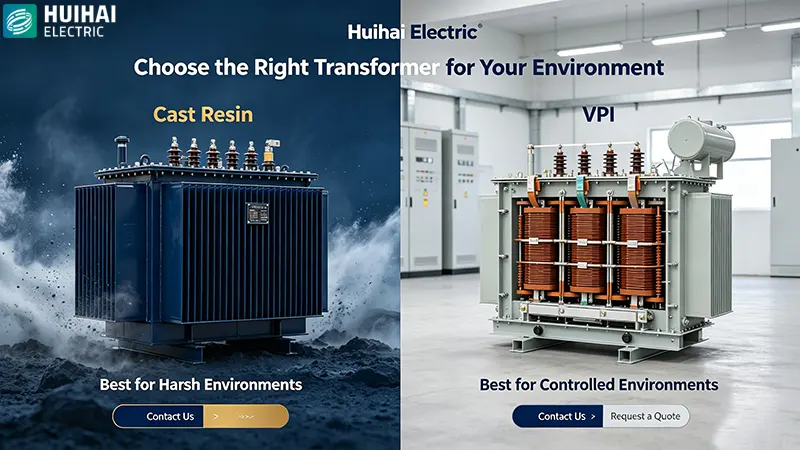
At Huihai Electric, we understand that no single transformer technology fits every application. That's why we manufacture both cast resin and VPI dry-type transformers—allowing our customers to select the optimal solution for their specific operating environment, budget, and performance requirements.
Our cast resin transformers feature:
- Full epoxy encapsulation for maximum environmental protection
- F1 fire safety rating with self-extinguishing properties
- Reliable operation in 100% humidity without drying-out periods
- Service life exceeding 30 years in demanding conditions
- Compliance with IEC 60076-11 and IEEE C57.12.01 standards
Our VPI transformers offer:
- Cost-effective solutions for standard indoor applications
- Compact, lightweight designs ideal for space-constrained installations
- Excellent thermal performance with open-wound cooling
- Full compliance with international standards
Whether your project requires the uncompromising protection of cast resin for a coastal substation or the cost-efficiency of VPI for a commercial building, Huihai Electric delivers reliable, high-performance solutions backed by decades of manufacturing expertise and rigorous quality control.
Need help selecting the right dry-type transformer for your harsh-environment project? [Contact Huihai Electric] to discuss your requirements with our engineering team or request technical documentation.
Written by
Huihai Electric Co., Ltd.
Editor Xu
www.huihai-electric.com
WhatsApp:+86 139 1136 0187
Email:info@huihai-electric.com
- 6 Advantages of Prefabricated Substations Over Traditional Stick-Built Designs
- Basic Winter Maintenance Measures for Oil-Immersed Transformers
- Avoid Costly Mistakes: 8 Dry-Type Transformer Specs to Verify Before Purchase
- High Voltage Switchgear Installation Guide: 10 Steps for Safe and Reliable Commissioning
HUIHAIElectric
Huihai Electric is a leading manufacturer of smart grid equipment in China.