Huihai
Electric
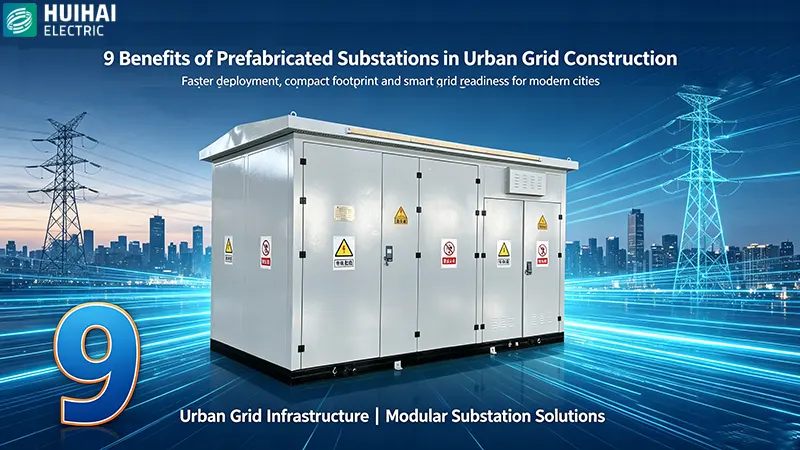
9 Key Benefits of Prefabricated Substation in Urban Grid Construction
Urban power grids are under unprecedented pressure. According to the International Energy Agency, global electricity demand is growing at its fastest pace in years, driven by data centers, electric vehicles, and the electrification of heating and industry. Yet the cities that need power most are precisely where building new infrastructure is hardest—land is scarce, approvals are slow, and communities resist construction disruption.
Traditional substation construction, with its 12-to-18-month timelines, extensive civil works, and sprawling footprints, is increasingly incompatible with these urban realities. The solution? Prefabricated substations—factory-built, modular power distribution units that are transforming how cities expand and reinforce their electrical infrastructure.
The global packaged substation market grew from $19.24 billion in 2025 to $20.95 billion in 2026 at a CAGR of 8.9% and is projected to reach $30.13 billion by 2030. This growth is no coincidence. Prefabricated substations address the core challenges of urban grid construction head-on: speed, space, cost, and resilience.
Below, we explore the 9 key benefits of prefabricated substations in urban grid construction—each one backed by real-world data and deployment experience from cities around the world.
1. Dramatically Faster Deployment — Up to 70% Construction Time Reduction
Benefit: Prefabricated substations compress construction timelines from months or years to weeks.
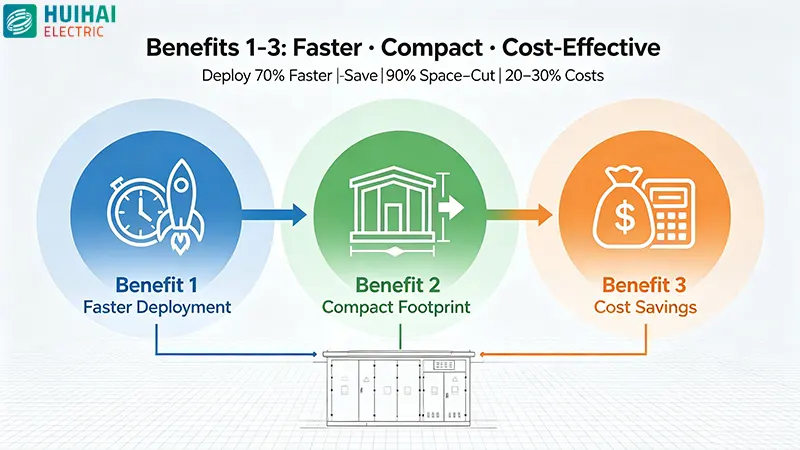
Time is the most visible advantage of prefabricated substations. Traditional high-voltage substations typically require 12 to 18 months to build from groundbreaking to energization. Prefabricated alternatives can be completed and delivered in as little as five months—reducing construction time by nearly 70%.
This speed comes from parallel workflows. While foundation work proceeds on-site, the substation's electrical systems—switchgear, transformers, protection equipment, and control systems—are being assembled and tested in a controlled factory environment. When the prefabricated units arrive, installation is rapid and straightforward.
Real-World Examples
- Jinhua, Zhejiang Province: China's first fully modular 500-kilovolt substation was completed in just 14 months using prefabricated assembly combined with intelligent systems.
- Yueyang, Hunan Province: The city's first prefabricated substation reduced on-site construction time significantly, with prefabricated wall panels installed as complete units to minimize noise disruption to surrounding residents.
- Linxia, Shanxi Province: A 35-kilovolt mobile prefabricated substation went from equipment arrival to energization in 25 days, providing a "hardcore" boost to local power supply reliability.
For urban utilities, faster deployment means faster revenue generation, earlier grid connection for new developments, and reduced exposure to construction-related risks such as weather delays and labor shortages.
2. Compact Footprint — Up to 90% Space Savings in Dense Urban Environments
Benefit: Prefabricated substations require a fraction of the land area of traditional designs.
In cities like Shanghai, London, or New York, land is the single most expensive and difficult-to-acquire resource. Traditional substations occupy 3 to 5 times more land area than prefabricated units due to spacing requirements between equipment and maintenance corridors.
Prefabricated substations invert this equation. Their modular, integrated design allows for dense packing of transformers, switchgear, and control systems into a single, compact enclosure.
Space Savings in Practice
Xi'an 110 kV Provincial Stadium Substation: The prefabricated cabin solution reduced the footprint to under 2,000 square meters—approximately 26% less land than a traditional substation of comparable capacity, significantly lowering land acquisition costs and construction difficulty in a core urban area.
Module Prefabrication Standards (Shaanxi Electric): Practiced across 38 projects, modular substation standards have reduced construction area by up to 90% compared to traditional layouts, with a 66% shorter construction period and 15% lower cost.
For urban utilities facing land scarcity, this space efficiency is not just a convenience—it is a necessity. A prefabricated substation can fit into sites that would be impossible for a traditional build: a corner of an existing parking lot, an unused strip along a roadway, or even underground spaces.
3. Significant Cost Reductions — 20-30% Lower Total Project Costs
Benefit: Prefabricated substations deliver substantial savings across the entire project lifecycle.
While the upfront equipment cost of a prefabricated substation may appear comparable to traditional alternatives, the total cost of ownership tells a very different story.
For 90% of urban, industrial, and renewable energy projects up to 35 kV, prefabricated substations offer a 20-30% reduction in overall costs. These savings come from multiple sources:
Civil Works Reduction
Traditional substations require extensive foundation digging, bricklaying, roofing, and ventilation systems. Prefabricated units need only a simple concrete plinth with cable trenches—reducing civil engineering expenses by over 80%.
Land Acquisition Savings
By occupying significantly less land, prefabricated substations reduce one of the largest cost components of urban infrastructure projects. In city centers where real estate is at a premium, this can translate into millions of dollars in savings.
Predictable Labor Costs
Factory integration means labor costs are fixed and predictable, eliminating the variables of on-site construction delays, weather disruptions, and labor shortages. The "AI PowerHouse" project in Qingdao, for example, reduced overall project costs by around 20% compared to conventional power facilities.
4. Superior Quality Control Through Factory-Based Manufacturing
Benefit: Controlled factory environments ensure consistent, high-quality construction.
Traditional stick-built substations are subject to the vagaries of on-site construction—weather delays, variable workmanship, and the inherent challenges of assembling complex electrical systems in the field. Prefabricated substations invert this model.
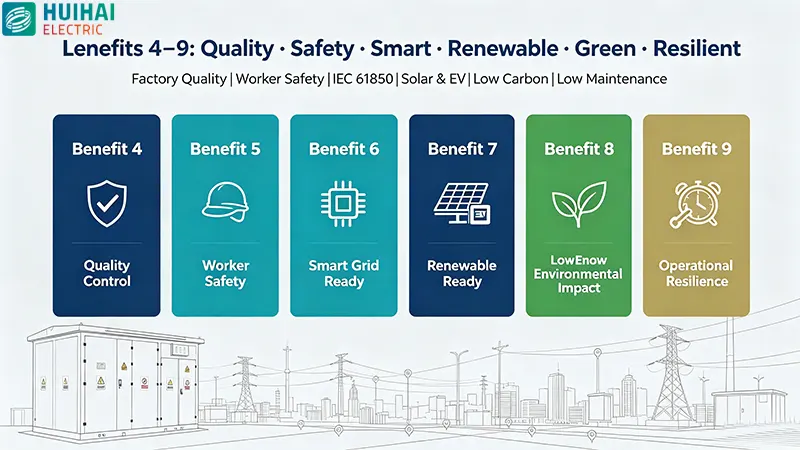
By manufacturing and assembling components in controlled factory environments, prefabricated substations ensure superior quality control through factory-based production, mitigating potential on-site construction defects.
Quality Advantages
- Standardized and repeatable designs that can be refined and optimized over multiple projects
- Factory pre-testing of all systems before shipment, reducing commissioning surprises
- Consistent workmanship unaffected by weather, site conditions, or variable labor skills
- Reduced on-site commissioning time because systems arrive pre-validated
Leading manufacturers achieve factory pre-installation rates of 98% for main equipment, meaning nearly all critical components are assembled and tested before leaving the factory.
5. Enhanced Safety for Workers and Communities
Benefit: Reduced on-site work lowers safety risks and community disruption.
Substation construction and operation present inherent safety risks. Prefabricated solutions significantly reduce these risks while delivering meaningful benefits for surrounding communities.
Worker Safety
- Reduced on-site work: With most assembly completed in the factory, workers spend less time in hazardous substation environments
- Shorter site exposure: Reduced construction timelines mean less time that workers and the public are exposed to construction-related hazards
- Controlled manufacturing environment: Factory production is inherently safer than on-site construction, with better safety protocols and equipment
Community Benefits
- Reduced noise pollution: Prefabricated substations generate less construction noise and, once operational, operate with significantly lower noise levels than traditional designs
- Less dust and pollution: Modular construction cuts dust emissions and supports environmental sustainability goals
- Minimized site disruption: With wet works substantially reduced at construction sites, on-site working conditions are improved and environmental impact is minimized
Xi'an's 110 kV substation is a prime example: its prefabricated cabins feature sound barriers, electromagnetic shielding, and noise-reduction patent technology, ensuring harmonious integration with the surrounding urban environment.
6. Smart Grid Ready — Integrated Monitoring and Remote Control
Benefit: Prefabricated substations are designed for digital integration from day one.
The modern grid is digital, and prefabricated substations are built for this reality. Unlike traditional designs that often require retrofitting for smart capabilities, prefabricated substations can integrate smart monitoring, control, and communication systems from the factory floor.
Smart Capabilities
- Remote monitoring and control: Operators can monitor substation performance, identify issues, and perform network management from anywhere
- IEC 61850 compatibility: Seamless integration with SCADA systems and other utility control platforms
- Predictive maintenance: Sensors and communication modules enable real-time thermal assessment and condition monitoring, reducing mean time to repair and enabling predictive maintenance regimes
- IoT integration: Data available through protocols including IEC 61850, DNP3.0, and Modbus
For urban utilities, these smart capabilities mean improved grid visibility, reduced outage durations, lower maintenance costs, and the ability to participate in increasingly complex grid management strategies.
7. Seamless Renewable Energy and EV Integration
Benefit: Prefabricated substations enable flexible, modular integration of distributed energy resources.
The increasing integration of renewable energy sources and electric vehicle charging infrastructure serves as a primary catalyst for the prefabricated substation market. Urban grids must accommodate:
- Rooftop solar installations that require efficient power collection and voltage regulation
- Battery energy storage systems that need bidirectional power flow capability
- EV charging networks that create dynamic, localized load spikes
- Distributed generation that requires more flexible and modular point-of-presence distribution assets
Prefabricated substations are uniquely suited to these applications. Their modular design allows for incremental capacity additions as renewable penetration grows, while their compact footprint makes them ideal for siting in the same urban areas where distributed energy resources are concentrated.
8. Reduced Environmental Impact Through Sustainable Construction
Benefit: Prefabricated substations minimize construction waste, emissions, and resource consumption.
Traditional substation construction generates significant environmental impact: concrete production, dust emissions, water consumption, and construction waste. Prefabricated substations dramatically reduce these impacts.
Environmental Advantages
- Reduced construction waste: Factory-based production generates less waste than on-site construction, and excess materials can be recycled more efficiently
- Lower carbon emissions: Prefabricated concrete structures can achieve an 11.37% reduction in carbon emissions compared to traditional cast-in-place reinforced concrete
- Minimized site disruption: Smaller site footprints and shorter construction periods mean less noise, traffic, and general disturbance
- Less dust and pollution: Modular construction cuts dust emissions and supports environmental sustainability goals
The Changsha project in Hunan Province exemplifies this environmental commitment: it used fluid solidified soil for foundation backfilling, turning engineering spoil into a primary raw material for resource recycling and reducing carbon emissions by over 30%. The main transformer used natural ester insulating oil with a degradation rate of nearly 100%, ensuring full-lifecycle carbon emissions far below traditional mineral oil transformers.
9. Long-Term Operational Resilience and Reduced Maintenance
Benefit: Prefabricated substations deliver decades of reliable service with minimal maintenance.
Beyond the construction phase, prefabricated substations offer significant operational advantages throughout their service life.
Reliability Features
- Weatherproof enclosures: IP54+ protection against rain, dust, and humidity
- Corrosion resistance: Suitable for coastal and high-pollution environments
- Seismic resilience: Designed to withstand seismic activity in active zones
- Factory-tested systems: Pre-validated components reduce the risk of start-up issues
Maintenance Advantages
- Remote diagnostics: Smart monitoring systems reduce the need for physical inspections
- Modular replacement: Individual components can be replaced without dismantling the entire system
- Predictive maintenance: Continuous health monitoring identifies degradation patterns before failure events
While traditional substations historically have a longer theoretical lifespan (40-50 years vs. 25-30 years for prefabricated units), modern prefabricated designs are closing this gap through advanced materials and construction techniques. For most urban applications, the operational benefits of prefabrication—faster deployment, lower maintenance, and smart capabilities—far outweigh the marginal difference in ultimate lifespan.
Summary: The 9 Benefits at a Glance
| # | Benefit | Key Advantage | Typical Impact |
|---|---|---|---|
| 1 | Faster Deployment | Parallel factory and site workflows | Up to 70% time reduction |
| 2 | Compact Footprint | Integrated modular design | Up to 90% space savings |
| 3 | Cost Reduction | Less civil work, land, and labor | 20-30% lower total cost |
| 4 | Quality Control | Factory-based manufacturing | 98% pre-installation rate |
| 5 | Safety Enhancement | Reduced on-site work | Fewer worker and community risks |
| 6 | Smart Grid Ready | IEC 61850, SCADA integration | Real-time monitoring and control |
| 7 | Renewable Integration | Modular, flexible capacity | Solar, wind, EV, and BESS compatible |
| 8 | Environmental Impact | Sustainable construction methods | 30%+ carbon reduction |
| 9 | Operational Resilience | Remote diagnostics, modular replacement | Lower maintenance costs |
Key Considerations for Selecting Prefabricated Substations in Urban Grid Projects
While the benefits of prefabricated substations are compelling, selecting the right solution requires careful attention to several factors:
Voltage Class and Application
Prefabricated substations are available across a wide range of voltage classes, from 12 kV distribution units to 500 kV transmission substations. For most urban grid construction projects, the 12-40.5 kV range is most common, covering medium-voltage distribution needs.
Enclosure Protection and Environmental Adaptation
Urban environments vary widely in their demands. Coastal cities require corrosion-resistant designs with high IP ratings. Inland cities with extreme temperature variations need thermal management systems. High-altitude installations require altitude-corrected insulation levels. When specifying prefabricated substations, ensure the enclosure design matches your site conditions.
Smart Grid Compatibility
Modern prefabricated substations should be equipped with IEC 61850-compatible communication protocols, remote terminal units (RTUs), and condition monitoring sensors. This ensures seamless integration with existing SCADA systems and future smart grid initiatives.
Standards Compliance
Ensure the prefabricated substation complies with applicable international standards, including IEC 62271-202 for prefabricated substations, IEC 60076 for transformers, and IEC 62271 series for high-voltage switchgear.
Why Huihai Electric for Your Prefabricated Substation Projects
At Huihai Electric, we understand that urban grid construction demands equipment engineered for the challenges of modern cities: space constraints, rapid deployment timelines, and smart grid integration. Our prefabricated substation portfolio includes:
- Intelligent Box-Type Substations: Equipped with RTU monitoring terminals and CCU communication controllers, enabling remote control, remote signaling, telemetry, and automatic meter reading
- Compact-Type Substations: Featuring HXGN15-12 or HXGN7A-12 ring main units and corrugated oil tank transformers, suitable for schemes with fewer outgoing lines
- Buried-Type Substations: Switch chamber and transformer arranged in a superimposed way, with the transformer buried underground to reduce occupied area and running noise
- Prefabricated Substation Enclosures: Available in non-metallic landscape, metal, aluminum alloy, and stainless steel configurations
All Huihai Electric prefabricated substations are designed and manufactured to meet IEC 62271-202, IEC 60076, and IEEE standards, with full type test reports from accredited independent laboratories.
Whether you are expanding an urban distribution network, integrating renewable energy capacity, or developing new smart city infrastructure, Huihai Electric delivers reliable, high-performance prefabricated substation solutions—engineered for the challenges of 2026 and beyond.
Written by
Huihai Electric Co., Ltd.
Editor Xu
www.huihai-electric.com
WhatsApp:+86 139 1136 0187
Email:info@huihai-electric.com
- Top 5 Digitalization Trends in Dry-Type Transformers: Smart Sensors & Predictive Maintenance
- 6 Advantages of Prefabricated Substations Over Traditional Stick-Built Designs
- Basic Winter Maintenance Measures for Oil-Immersed Transformers
- Top 7 Applications Driving Dry-Type Transformer Demand in 2026 — From Data Centers to Petrochemicals
HUIHAIElectric
Huihai Electric is a leading manufacturer of smart grid equipment in China.