Huihai
Electric
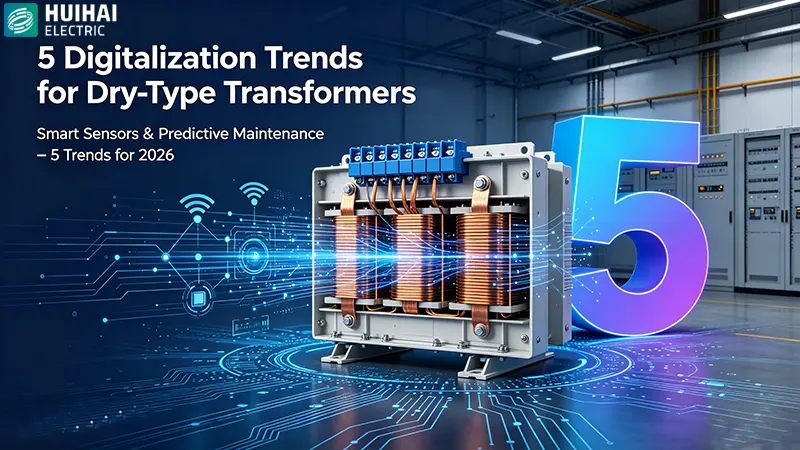
Top 5 Digitalization Trends in Dry-Type Transformers: Smart Sensors & Predictive Maintenance
Discover the top 5 digitalization trends transforming dry-type transformers in 2026-from IoT sensors and predictive maintenance to digital twins and AI-driven fault detection.
The dry-type transformer-once a straightforward piece of electrical infrastructure-is undergoing a profound digital transformation. No longer passive components that simply step voltage up or down, today's dry-type transformers are becoming intelligent, data-generating assets at the heart of modern power distribution networks.
The numbers tell the story. The global dry-type transformer market is projected to grow from USD 11.72 billion in 2025 to USD 16.33 billion by 2030, at a CAGR of 6.9%. More significantly, the smart transformers market-which includes digitally enabled dry-type units-was valued at USD 3.98 billion in 2025 and is projected to reach USD 8.17 billion by 2032, growing at a CAGR of 10.79%.
What's driving this transformation? The industry is currently characterized by a fundamental shift toward energy-efficient designs and the integration of digital monitoring systems to support smart grid initiatives. Here are the top 5 digitalization trends reshaping dry-type transformers in 2026.
1. From Manual Inspections to IoT-Enabled Real-Time Monitoring
Traditional transformer maintenance relied heavily on periodic manual inspections-technicians would physically check operating temperatures, insulation resistance, and external conditions at scheduled intervals. This approach worked when substations contained a limited number of devices, but it is increasingly insufficient for modern digital substations and distributed energy networks.
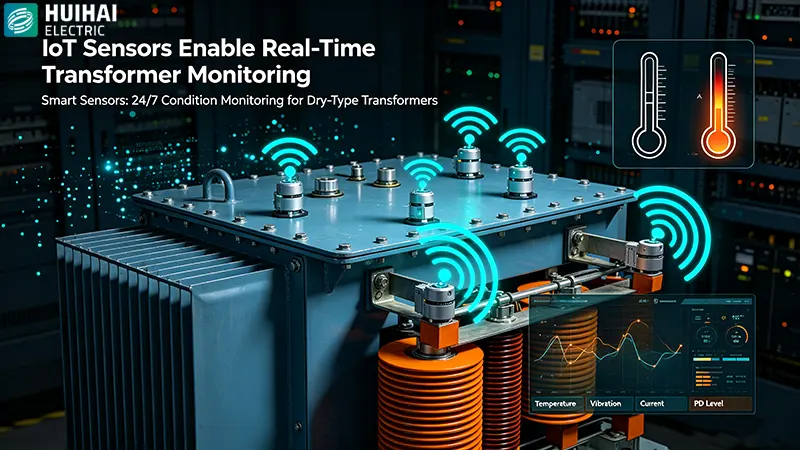
Today, dry-type transformers are being fitted with sensors, communication modules, and IoT-based diagnostics to enable real-time condition monitoring and fault prediction. Instead of waiting for human intervention, transformers can now continuously report their operating status in real time.
What this looks like in practice:
- Continuous thermal monitoring: Fiber optic temperature sensing technology is becoming widely adopted in high-voltage dry-type transformers. Unlike conventional thermal resistors, fiber optic sensors can be embedded directly inside transformer windings to measure actual hotspot temperatures rather than estimating them through external conditions. This capability is especially critical in high-altitude, high-temperature, or heavily loaded environments.
- Remote visibility: Operators can now monitor voltage, current, temperature, and other critical parameters from anywhere. This real-time visibility enhances grid resilience, optimizes energy flow, and supports predictive maintenance strategies that reduce downtime and operating costs.
The shift is so significant that value is now being added through the provision of "smart" monitoring kits and lifecycle services, including predictive maintenance and retrofitting of digital modules.
2. Predictive Maintenance - Moving Beyond Reactive Repairs
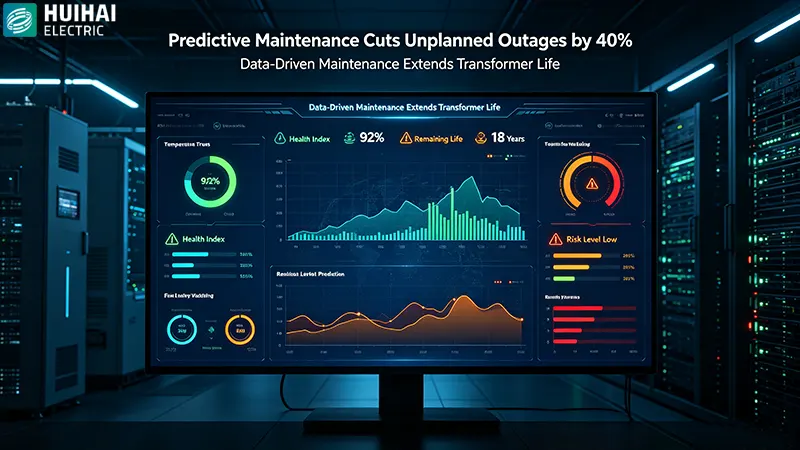
Perhaps the most transformative trend is the evolution from reactive or time-based maintenance to predictive maintenance. Digitalization of asset management has moved beyond monitoring to predictive maintenance models, enabling condition-based intervention that extends service life and reduces unplanned outages.
How predictive maintenance works:
Operational data is uploaded to cloud-based platforms, where it can be combined with historical load curves and environmental conditions to generate predictive maintenance recommendations and remaining service life estimations.
The business case:
- The transformer monitoring system market is increasingly driven by predictive maintenance and grid digitalization mandates rather than pure asset protection.
- Industry data shows that deploying intelligent monitoring devices can reduce unplanned outage rates by over 40%.
- The continuous thermal monitoring market alone is projected to reach USD 1.49 billion by 2030.
- Smart transformer monitoring systems enable cost reduction benefits through predictive maintenance.
Utilities are increasingly investing in automation-ready, sensor-enabled dry-type transformers to boost grid resilience, lower maintenance costs, and meet modern safety and efficiency standards. The integration of predictive maintenance capabilities is reducing transformer failure-related outage costs as continuous health monitoring identifies degradation patterns weeks before failure events.
3. Multi-Layer Diagnostic Technologies - Beyond Temperature Alone
Modern dry-type transformer monitoring systems integrate multiple layers of diagnostic technologies, creating a comprehensive picture of transformer health.
Partial Discharge Detection
Partial discharge is one of the earliest indicators of insulation degradation inside dry-type transformers. By combining ultrasonic sensors with high-frequency current transformers and intelligent signal processing algorithms, operators can continuously monitor discharge trends without shutting down equipment. This shifts fault detection from the stage of visible discharge failure to the much earlier stage of insulation deterioration.
Vibration and Noise Analysis
Mechanical abnormalities in transformer cores often appear before major electrical parameter changes occur. Acceleration sensors can collect vibration spectrum data and compare it with normal operating baselines to identify problems such as loose core structures or insulation damage between silicon steel laminations. Some advanced monitoring platforms also integrate acoustic pattern recognition technology to analyze operating sound signatures collected through industrial microphones.
Advanced Winding Temperature Monitoring
PT100 resistance temperature detectors remain the preferred solution for dry-type transformer monitoring, offering reliable performance in less demanding electromagnetic environments. For more demanding applications, fiber optic hotspot sensing can be added to online monitoring installations.
This multi-layer approach means that no single point of failure goes undetected-temperature anomalies, partial discharge activity, and mechanical vibrations are all captured and analyzed in a unified platform.
4. Digital Twins and AI-Driven Health Management
The frontier of dry-type transformer digitalization is the digital twin-a virtual replica of the physical transformer that enables predictive simulation and advanced health management.
Recent research has demonstrated the potential of digital twin technology in transformer health management. A five-dimensional digital twin model, combined with an electromagnetic-thermal-fluid multi-physics coupling model, can generate high-frequency time-series data to simulate fault conditions and build comprehensive diagnostic databases.
What digital twins enable:
- Fault identification: Machine learning classifiers can identify emerging fault patterns from operational data.
- Trend prediction: Time-series-based algorithms forecast degradation trajectories before failures occur.
- State evaluation: Threshold-mapping and weighted-fusion methods provide intuitive health assessments.
The incorporation of digital twin capabilities further refines operational decision-making by simulating real-world grid scenarios, enabling operators to preemptively address vulnerabilities and optimize performance parameters.
As AI and machine learning algorithms process vast streams of operational data, asset managers can predict equipment wear and dynamically adjust maintenance schedules, leading to heightened reliability and cost-effective operations.
5. Data Services as a Competitive Advantage
The digitalization of dry-type transformers is reshaping the competitive landscape. Competition is no longer based solely on hardware performance-data services and intelligent maintenance capabilities are becoming important competitive advantages.
What this means for the industry:
- Hardware + software bundles: Several transformer manufacturers have started integrating full lifecycle management platforms into their product offerings.
- Predictive analytics modules: Smart transformers now come with predictive analytics capabilities that reduce downtime and operating costs.
- IEC 61850 integration: The integration of IEC 61850 communication protocols enables device interoperability and intelligent system operation and maintenance.
- Edge computing: Advanced sensors with edge computing capabilities enable on-device analytics, reducing latency and enhancing decision-making at the network edge.
The smart/connected transformer category is expected to be the fastest grower, expanding at 14–18% CAGR and reaching a 15–20% unit share by 2035, as grid operators and large facility owners adopt predictive maintenance and real-time load management.
The upfront investment in smart transformer technology is increasingly justified by long-term savings from reduced downtime and streamlined asset management processes.
The Regulatory Push Behind Digitalization
Digitalization is not happening in a vacuum-it is being accelerated by regulatory mandates. In China, for example, policies such as the "Energy-Saving Equipment High-Quality Development Implementation Plan (2026–2028)" mandate that by 2028, new energy-saving transformers account for ≥75% and in-service energy-saving transformers account for 15%. Meeting these targets requires more than just improved core materials-it demands intelligent monitoring, load optimization, and fault prediction to achieve operational energy efficiency gains.
Similarly, the State Council's "15th Five-Year Carbon Peaking Action Plan" drives "digital" (digital grafting)-replacing transformers with tier-one energy-efficient dry-type transformers while adding intelligent sensing terminals (temperature, partial discharge, vibration) connected to enterprise energy management systems.
These regulatory frameworks are making smart, digitally enabled dry-type transformers not just a competitive advantage-but a compliance necessity.
Why Huihai Electric Leads in Dry-Type Transformer Digitalization
At Huihai Electric, we understand that the future of power distribution is digital. Our dry-type transformers are engineered to embrace these five digitalization trends:
- IoT-enabled monitoring: Sensor-ready designs with communication modules for real-time condition monitoring
- Predictive maintenance capability: Built to integrate with cloud-based analytics platforms for remaining life estimation
- Multi-layer diagnostics: Compatible with temperature, partial discharge, and vibration monitoring systems
- Digital twin readiness: Designed to support advanced health management and simulation capabilities
- Standards compliance: Full adherence to IEC 60076-11, IEEE C57.12.01, and IEC 61850 communication protocols
Whether you are modernizing an urban substation, expanding a data center, or integrating renewable energy, Huihai Electric delivers dry-type transformers that are not just power equipment-they are intelligent grid assets built for the digital age.
Ready to explore how smart dry-type transformers can transform your power infrastructure? Contact Huihai Electric to discuss your digitalization needs or request technical documentation.
Written by
Huihai Electric Co., Ltd.
Editor Xu
www.huihai-electric.com
WhatsApp:+86 139 1136 0187
Email:info@huihai-electric.com
- Top 5 Resin Technologies That Are Extending Dry-Type Transformer Life Beyond 35 Years
- Cast Resin vs. VPI: Which Dry-Type Transformer Is Best for Harsh Environments?
- 7 Reasons Dry-Type Transformers Are Replacing Oil-Filled Units in 2026 Smart Grid Projects
- The 7 Major Causes of Excessive No-Load Current in Dry-Type Transformers
HUIHAIElectric
Huihai Electric is a leading manufacturer of smart grid equipment in China.