Huihai
Electric
7 Maintenance Best Practices to Extend High Voltage Switchgear Service Life Beyond 30 Years
High voltage switchgear is the nervous center of any power distribution system. It controls, protects, and isolates electrical circuits in utility substations, industrial facilities, data centers, and renewable energy plants. Yet despite its critical role, switchgear is often maintained on a "run-to-failure" basis—a strategy that leads to catastrophic outages, safety hazards, and millions of dollars in operational losses.
The good news? Targeted reconditioning and structured maintenance can significantly extend the operational lifetime of switchgear beyond its expected lifespan. Studies show that proactive maintenance can increase equipment life by 30-50%. With the right practices in place, high voltage switchgear can reliably serve for 30 years or more.
Here are 7 maintenance best practices to help you achieve that goal.

1. Perform Daily Visual Inspections — The First Line of Defense
The most effective maintenance starts with the simplest action: a daily walk-around visual inspection. You don't need to open cabinets or de-energize equipment—just look, listen, and observe.
What to check daily:
- Discoloration or burn marks — Brown or black marks on insulators indicate overheating.
- Cracks, corrosion, or discoloration on enclosures and insulation layers.
- Moisture or condensation on windows — this often means cabinet heaters are malfunctioning.
- Status indicators — Verify that "Open/Closed" flags match the actual system status.
- Labels and warning signs — Ensure they remain.
- Abnormal noises — Humming, buzzing, or arcing sounds may indicate contact failure or insulation breakdown. Investigate immediately.
Why it matters: Daily visual inspections can prevent 80% of common failures. Most switchgear problems give visual warning signs long before they become catastrophic—if you know what to look for.
2. Implement Continuous and Periodic Temperature Monitoring
Temperature abnormalities are the primary indicator of equipment deterioration. Every 10°C rise in operating temperature can halve the equipment's expected lifespan.
Monitoring priorities:
- Circuit breaker contacts — Moving and static contacts generate the most heat due to contact resistance and arcing.
- Busbar connections — High current loads make any loose connection a potential hotspot.
- Cable joints — Contact resistance increases over time due to thermal cycling and mechanical stress.
- Isolator switch blades — Mechanical wear leads to poor contact and excessive heating.
Monitoring methods:
| Method | Accuracy | Best For |
| Infrared thermography | ±2°C | Monthly scans of terminations and joints |
| Fluorescent fiber optic sensors | ±0.5°C | Continuous 24/7 monitoring in high-voltage environments |
| Wireless temperature sensors | ±1°C | Real-time alerts on busbars |
Industry standard: NETA standards suggest that a temperature difference (ΔT) of >15°C between similar components requires immediate attention.
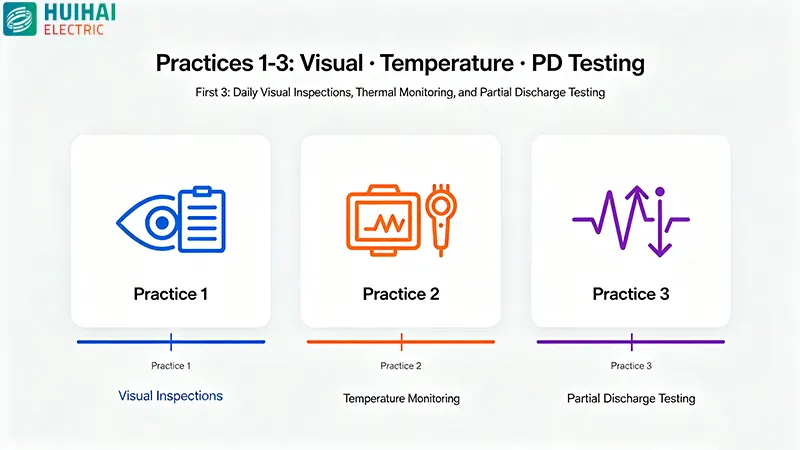
3. Conduct Regular Partial Discharge (PD) Testing
Partial discharge (PD) is one of the most sensitive indicators of insulation quality and long-term reliability. PD testing detects microscopic electrical discharges within insulation voids, cracks, or contamination—defects that will worsen over time and eventually lead to insulation failure.
Why PD testing matters:
- Approximately 90% of GIS failures are preceded by detectable PD activity
- Periodic PD monitoring is essential for early detection of insulation issues
- PD testing plays a pivotal role in determining HV asset health
Recommended intervals:
- Baseline measurement — Conduct during commissioning
- Periodic monitoring — Follow-up inspections recommended at 12-month intervals
- Continuous monitoring — For critical assets, consider online PD monitoring systems
For GIS equipment: Partial discharge monitoring using UHF and ultrasonic sensors is one of the leading diagnostic techniques to predict potential failures.
For AIS equipment: PD monitoring places greater emphasis on environmental correlation and surface condition.
4. Implement SF6 Gas Quality Management (For GIS)
For gas-insulated switchgear, SF6 gas quality is the single most important factor determining insulation integrity and operational reliability.
Key gas management tasks:
- Daily checks — Monitor gas pressure gauges and density indicators
- Four-yearly SF6 gas quality checks — Comprehensive gas analysis
- Leak detection — Identify and repair gas leaks promptly
- Moisture control — Maintain dew point within specified limits
- Gas handling — Follow IEC 62271-4 procedures for gas handling during installation, commissioning, repair, and overhaul
Why it matters: Insufficient SF6 density compromises insulation strength and interrupt capacity. Loss of gas integrity is one of the most common failure modes in GIS.
Emerging standards: For newer CO₂-insulated GIS equipment (72.5kV and above), refer to T/CES 236-2023 for specific operation and maintenance requirements.
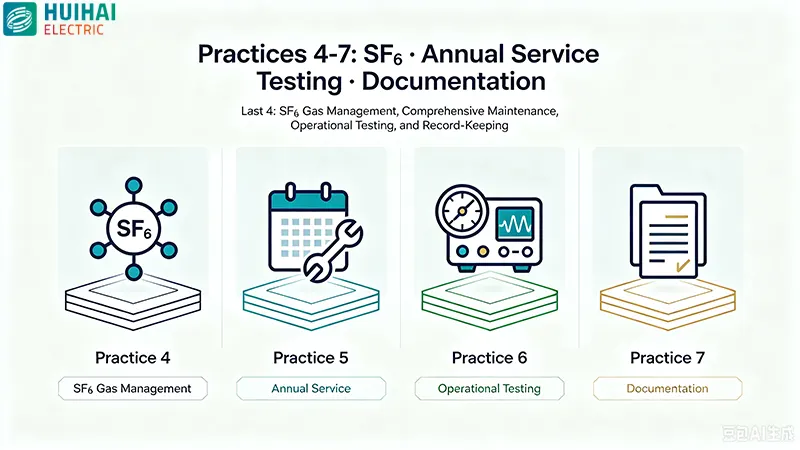
5. Perform Comprehensive Annual Maintenance During Scheduled Shutdowns
Once a year, schedule a complete shutdown for deep maintenance. This is when you can access components that are inaccessible during normal operation.
Annual maintenance checklist:
- Safe power-off procedure — Follow proper sequence: high voltage to low voltage, main switches to branch switches. Verify absence of voltage and install grounding wires.
- Deep cleaning — Vacuum (never blow) dust from cabinet interiors. Wipe insulators with lint-free cloth and approved solvent. Remove dust from bus bars, connections, supports, and enclosures.
- Insulation testing — Perform megohmmeter (megger) readings between phases and each phase to ground.
- Contact resistance measurement — This is the single most reliable diagnostic procedure to verify electrical contact integrity before degradation becomes a failure.
- Mechanical lubrication — Apply insulating grease to moving parts such as circuit breaker springs and isolator hinges.
- Protective coating inspection — Check for severe rust, peeling, or flaking.
- Control wiring inspection — Verify tightness and check for damage.
First-year special inspection: The switchgear installation should be given a thorough overall maintenance check at the end of the first year in service.
6. Perform Mechanical and Electrical Operational Testing
Switchgear must perform reliably over thousands of mechanical operations—opening and closing under both normal and fault conditions. Regular testing validates that performance.
Key tests:
- Circuit breaker timing tests — Measure operating time, pole discrepancy, and pre-insertion resistor timing
- Mechanical operation tests — Perform multiple open/close operations to verify mechanism integrity
- Trip unit testing — Verify protection relays trip and alarm as configured
- Capacitance and TanDelta measurements — Assess insulation condition
- Arc chute inspection — Check for contact erosion and arc damage
Why it matters: A stuck mechanism or failed spring can mean the difference between a contained fault and a widespread outage. Regular testing ensures that when the breaker needs to operate, it will.
7. Maintain Comprehensive Documentation and Condition Assessment
You cannot manage what you do not measure. Comprehensive record-keeping is the foundation of effective long-term asset management.
What to document:
- Maintenance logs — Record all inspections, tests, repairs, and replacements
- Test results — Baseline and trending data for temperature, PD, contact resistance, and insulation resistance
- Failure records — Document all faults, their causes, and corrective actions
- Gas records — For GIS, maintain SF6 pressure, quality, and leak history
- Visual inspection photos — Document changes over time
Advanced condition assessment:
Research has demonstrated that targeted reconditioning based on structured evaluation can significantly extend switchgear operational lifetime. The "Worst Code" evaluation method—which focuses on the condition of the most degraded component rather than averaging scores—provides a more accurate reflection of switchgear operational condition.
Industry shift: The utility industry has transitioned entirely from time-based maintenance to data-driven Condition-Based Maintenance (CBM) guided by Prognostics and Health Management (PHM). This approach allows intervention only when sensors detect measurable degradation, optimizing maintenance intervals and significantly reducing the probability of unplanned catastrophic failure.

Summary: The 7 Best Practices at a Glance
| # | Best Practice | Frequency | Key Benefit |
| 1 | Daily Visual Inspections | Daily | Prevents 80% of common failures |
| 2 | Temperature Monitoring | Monthly / Continuous | Prevents overheating-related failures |
| 3 | Partial Discharge Testing | Annually / Continuous | Early detection of insulation degradation |
| 4 | SF6 Gas Quality Management | Daily / 4-Yearly | Maintains GIS insulation integrity |
| 5 | Annual Comprehensive Maintenance | Annually | Deep cleaning, testing, and lubrication |
| 6 | Mechanical & Electrical Testing | Annually | Validates operational reliability |
| 7 | Documentation & Condition Assessment | Ongoing | Enables data-driven maintenance decisions |
The Business Case for Proactive Maintenance
Preventive maintenance ROI reaches 300%—compared to emergency repairs, planned maintenance costs only one-third while avoiding production losses.
Consider the alternatives:
- Reactive maintenance — Fix after failure. Highest cost, longest downtime, greatest safety risk.
- Time-based maintenance — Overhaul on fixed schedule. Often introduces more risk than benefit.
- Condition-based maintenance — Intervene only when needed. Optimal cost, minimal downtime, maximum asset life.
The choice is clear. A structured, proactive maintenance program is not an expense—it is an investment that pays dividends in reliability, safety, and extended asset life.
Why Huihai Electric for Your Switchgear Needs
At Huihai Electric, we understand that switchgear reliability starts with quality manufacturing—but it doesn't end there. Our high voltage switchgear portfolio—available in both Gas-Insulated Switchgear (GIS) and Air-Insulated Switchgear (AIS) configurations—is designed and manufactured to meet the most stringent international standards, including IEC 62271 and IEEE C37 series.
What Huihai Electric delivers:
- Full type test reports from accredited independent laboratories
- Rigorous quality control throughout manufacturing
- Mechanisms rated for 30,000+ operations — reducing mechanical wear
- Interlock mechanisms that physically prevent unsafe operations
- Comprehensive documentation including installation and maintenance manuals
- Global technical support for maintenance planning and troubleshooting
Whether you are specifying new switchgear or developing a maintenance program for existing assets, Huihai Electric is your partner in reliable, long-term power distribution.
Written by
Huihai Electric Co., Ltd.
Editor Xu
www.huihai-electric.com
WhatsApp:+86 139 1136 0187
Email:info@huihai-electric.com
- 6 Advantages of Prefabricated Substations Over Traditional Stick-Built Designs
- Basic Winter Maintenance Measures for Oil-Immersed Transformers
- Avoid Costly Mistakes: 8 Dry-Type Transformer Specs to Verify Before Purchase
- High Voltage Switchgear Installation Guide: 10 Steps for Safe and Reliable Commissioning
HUIHAIElectric
Huihai Electric is a leading manufacturer of smart grid equipment in China.